
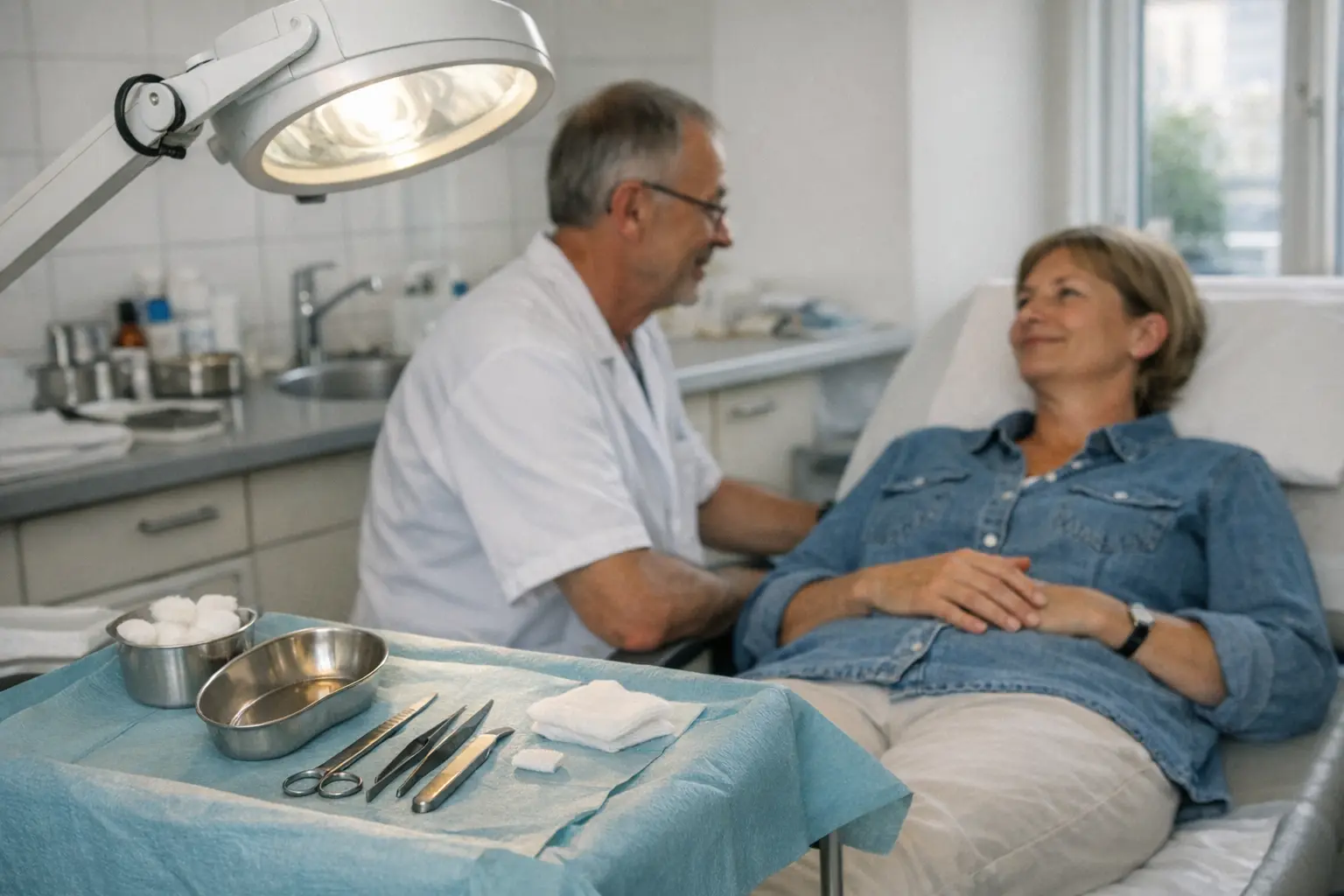
Whether it's a suspicious mole, a bothersome age wart, or a small skin tumor: many skin lesions can be removed in a brief procedure under local anesthesia. The tissue is then usually examined in a laboratory — so you receive certainty about what it was. The procedure typically takes place directly in the practice.
Typical Areas of Use
- Suspicious or changing moles
- Suspected non-melanoma skin cancer or its precursors
- Bothersome benign skin lesions such as fibromas or age warts
- Sebaceous cysts (epidermoid cysts)
- Repeatedly irritated or bleeding skin areas
How It Works
- 1The dermatologist examines the skin area, often with a dermatoscope, and discusses with you whether and how the lesion should be removed.
- 2The area is numbed with local anesthesia — only the small prick of the injection is briefly noticeable, after which you are pain-free.
- 3Depending on the type, the lesion is either excised, shaved off, or treated with cryotherapy or electrocautery; if an incision is made, the wound is closed with fine stitches.
- 4Removed tissue is usually sent to the laboratory for histopathological examination; you receive the result after approximately one to two weeks.
- 5You receive a dressing or small bandage and can go home directly.
How to Prepare
- Inform the doctor about blood-thinning medications, allergies (such as to anesthetics or adhesive plasters), and any tendency toward wound healing problems.
- The treated area should be free of make-up and creams on the day of the appointment.
Side Effects & Risks
- A scar remains with every incision — usually fine and inconspicuous, but depending on skin type and body location it may be more visible.
- Post-operative bleeding or bruising, especially when taking blood thinners.
- Rarely, wound infections, recognizable by increasing redness, swelling, and pain.
- Temporary numbness around the scar is possible.
- Depending on the findings, a follow-up operation may be necessary, for example if the laboratory recommends complete removal.
Keep the wound dry and clean for the first few days and change the dressing as instructed; brief showers are usually permitted soon, but baths, swimming pools, and saunas only after healing is complete. Avoid tension and stretching on the suture — depending on the body location, this means: no strenuous exercise for several days to weeks. Protect the fresh scar from the sun for several months so that it remains inconspicuous. Contact us if the wound bleeds heavily, becomes increasingly painful, red, or warm, or if fever occurs — and do ask if you haven't heard anything about the laboratory result after two weeks.
Cost & Insurance
The removal of medically justified skin lesions — for example, in case of suspected malignancy or repeatedly inflamed areas — is covered by basic health insurance, including laboratory examination; the deductible and co-payment apply as usual. Purely cosmetic removals, such as an unremarkable but bothersome mole, you pay for yourself. Your dermatologist will tell you before the procedure how your case is classified; if in doubt, it's worth inquiring with your insurance company — without guarantee.
Frequently Asked Questions
- Does removing a skin lesion hurt?
- Only the small prick of the anesthetic injection is briefly unpleasant — the procedure itself is pain-free. After the anesthesia wears off, the area may be tender for a few days.
- Will a scar remain?
- With an incision, yes, but usually fine and inconspicuous over time. How visible a scar becomes depends on body location, skin type, and wound care — consistent sun protection helps.
- Why is the tissue sent to a laboratory?
- Only histopathological examination can reliably determine whether a lesion was benign or malignant and whether it was completely removed. You typically receive the result within one to two weeks.
- What does removal of a mole cost?
- In case of medical suspicion, basic health insurance covers the procedure including laboratory examination, minus the Franchise and co-payment. Purely cosmetic removals you pay for yourself — the practice will inform you of the costs in advance.
- May I shower and exercise after the procedure?
- Brief showers are usually allowed after one to two days; gently pat the wound dry afterwards. With exercise that pulls on the suture or causes heavy sweating, it's better to wait until the stitches are removed — ask your doctor about the appropriate timing.