
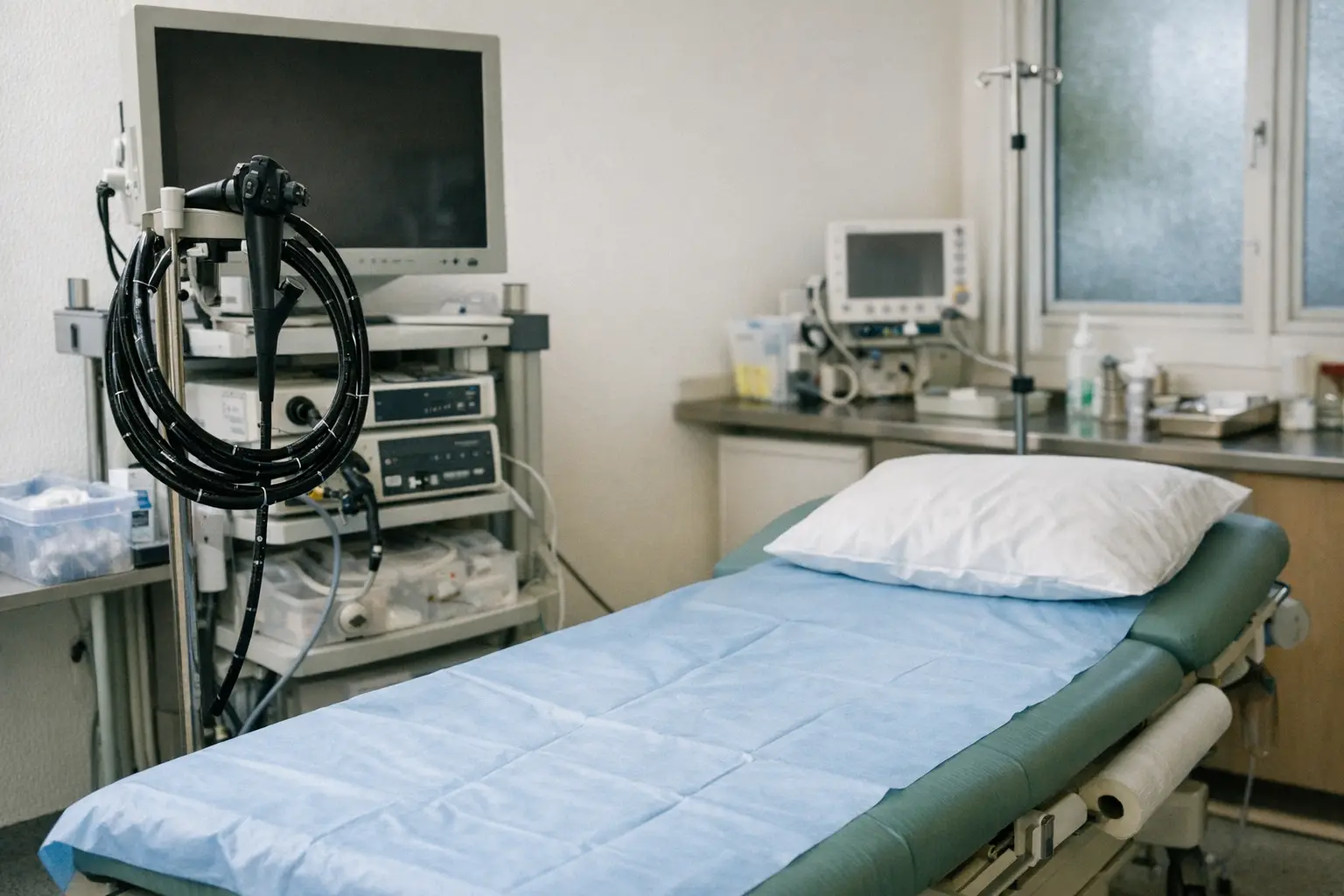
During a gastroscopy, the gastroenterologist examines your oesophagus, stomach and duodenum using a thin, flexible tube with a camera. The examination investigates symptoms such as persistent heartburn or upper abdominal pain — and allows tissue samples to be taken directly.
Typical Areas of Use
- Persistent heartburn and acid reflux
- Difficulty swallowing
- Recurrent upper abdominal pain and nausea
- Suspected gastric or duodenal ulcer
- Investigation of unexplained anaemia
How It Works
- 1You attend fasting; your throat is anaesthetised locally, and on request — which most people choose — you receive a short-acting sedative through a vein.
- 2You lie on your left side and a small bite guard is placed between your teeth; the tube is carefully inserted through your mouth.
- 3The doctor examines your oesophagus, stomach and duodenum; some air is inflated for this purpose. If necessary, small tissue samples are taken painlessly.
- 4The actual examination takes about 10 to 15 minutes; afterwards you recover in the recovery area.
- 5The doctor discusses the initial findings with you; results from tissue samples follow after a few days.
How to Prepare
- You must be fasting — usually nothing to eat for at least six hours; the practice's instructions are definitive.
- Arrange for someone to accompany you if you receive a sleeping medication: driving yourself is generally not permitted for 24 hours afterwards — the information provided by the centre is decisive.
- Discuss blood-thinning medications with your doctor in advance — they will decide whether and how these need to be adjusted.
- Removable dentures are taken out before the examination.
Side Effects & Risks
- A slight scratchy feeling in the throat and bloating from the inflated air are normal after the examination and subside quickly.
- After tissue samples are taken, minor bleeding can rarely occur, which usually stops on its own.
- Very rarely, injury to the mucous membrane or organ wall can occur.
- The sedative can affect circulation and breathing — you are therefore monitored during and after the examination.
After taking a sleep medication, you must not drive any vehicle, operate machinery, or make important decisions for 24 hours — please arrange for someone to pick you up. Do not eat or drink until the numbness in your throat has completely worn off, otherwise there is a risk of choking. Sore throat and a bloated feeling on the same day are normal. Get in touch immediately if you experience severe or worsening abdominal pain, fever, vomiting blood, or black-coloured stool.

Cost & Insurance
A medically justified gastroscopy is usually covered by basic insurance; the deductible and co-payment apply as usual. A referral from your GP to a gastroenterology practice or hospital is customary. If in doubt, check with your health insurer; this information is provided for guidance only and without guarantee.
Frequently Asked Questions
- Does a gastroscopy hurt?
- No — with throat anaesthetic and brief sedation, most people are not aware of the examination at all. Without sedation, the gag reflex when inserting the tube is unpleasant but quite bearable; the examination does not cause pain.
- Do I have to have the sedative?
- No, that is your decision. Many choose it for comfort; anyone who wants to be able to drive immediately afterwards can have the examination with throat anaesthetic alone. Discuss the options with your doctor in advance.
- How long does a gastroscopy take?
- The examination itself only about 10 to 15 minutes. With the briefing, preparation and recovery phase, you will spend a total of about one to two hours at the practice or hospital.
- Can I drive afterwards?
- Not after sedation: a strict driving ban applies for 24 hours, and you should arrange to be collected. Without sedation, with throat anaesthetic only, you can drive once the anaesthetic has worn off.
- When will I find out the result?
- The doctor usually discusses the initial findings with you directly after the examination. Results from tissue samples, such as the test for the stomach bacterium Helicobacter, follow after a few days.
- What happens if something abnormal is found?
- Many things can be addressed directly during the examination: tissue samples are taken, minor bleeding can be stopped. The doctor will then discuss the further course of action — such as medication — with you afterwards at leisure.