
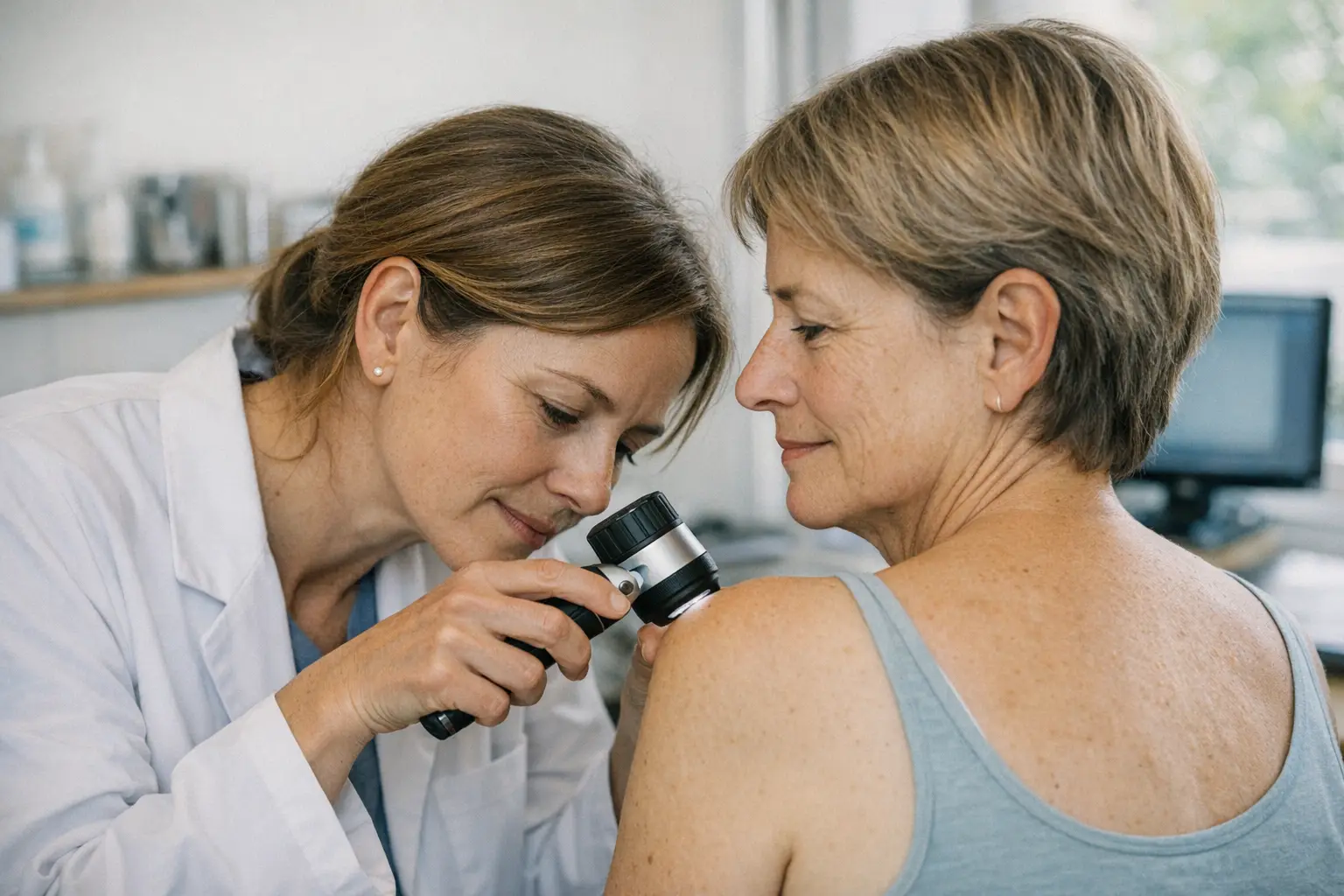
Moles are usually harmless clusters of pigment-producing cells. However, if a mole changes in size, shape, colour or border, it should be professionally assessed without alarm. Such an examination serves your safety and is a normal, calm part of skin care.
Possible causes
Natural changes
Moles can change slowly over the course of life, for example due to ageing or hormonal changes.
Sun exposure
Intense UV exposure and sunburn affect the skin and the number of moles over the years.
Predisposition
Many moles or fair skin type in the family increase the attention that should be given to skin monitoring.
Irritation
Mechanical friction, for example from clothing, can irritate a mole and temporarily change its appearance.

Typical steps at the doctor's office
- 1The dermatologist examines the mole, often using a magnifying lamp (dermatoscope), and assesses its shape, colour and border.
- 2If findings are unclear, monitoring over time or taking a tissue sample for more detailed assessment may be suggested.
- 3Further steps depend on the results and range from regular observation to removal of the mole.
What you can do yourself
- Examine your own skin from time to time and watch for changes in size, shape or colour.
- For areas that are difficult to see, such as your back, use a mirror or ask another person for help.
- Maintain consistent sun protection with clothing, shade and sunscreen, and avoid sunburn.
- Photograph conspicuous areas with your mobile phone to better detect changes over time.
A mole that changes in size, shape or colour, appears newly or feels different should be assessed by a dermatologist. Such an examination is not a diagnosis, but rather a sensible precautionary measure that provides clarity quickly and easily.

Frequently asked questions
- When is a mole considered conspicuous?
- Indicators are changes in size, shape, colour or border, as well as a mole that looks different from the others. When in doubt, an examination is worthwhile.
- How often should I have moles checked?
- This depends on skin type, number of moles and medical history. Your doctor will give you an individual recommendation.
- Does a changed mole always have to be removed?
- No. Many moles are only monitored. Whether removal makes sense is decided after professional assessment.
Not sure whether you should go or whom to see? Describe your symptoms — we'll find the right practice in your area.