
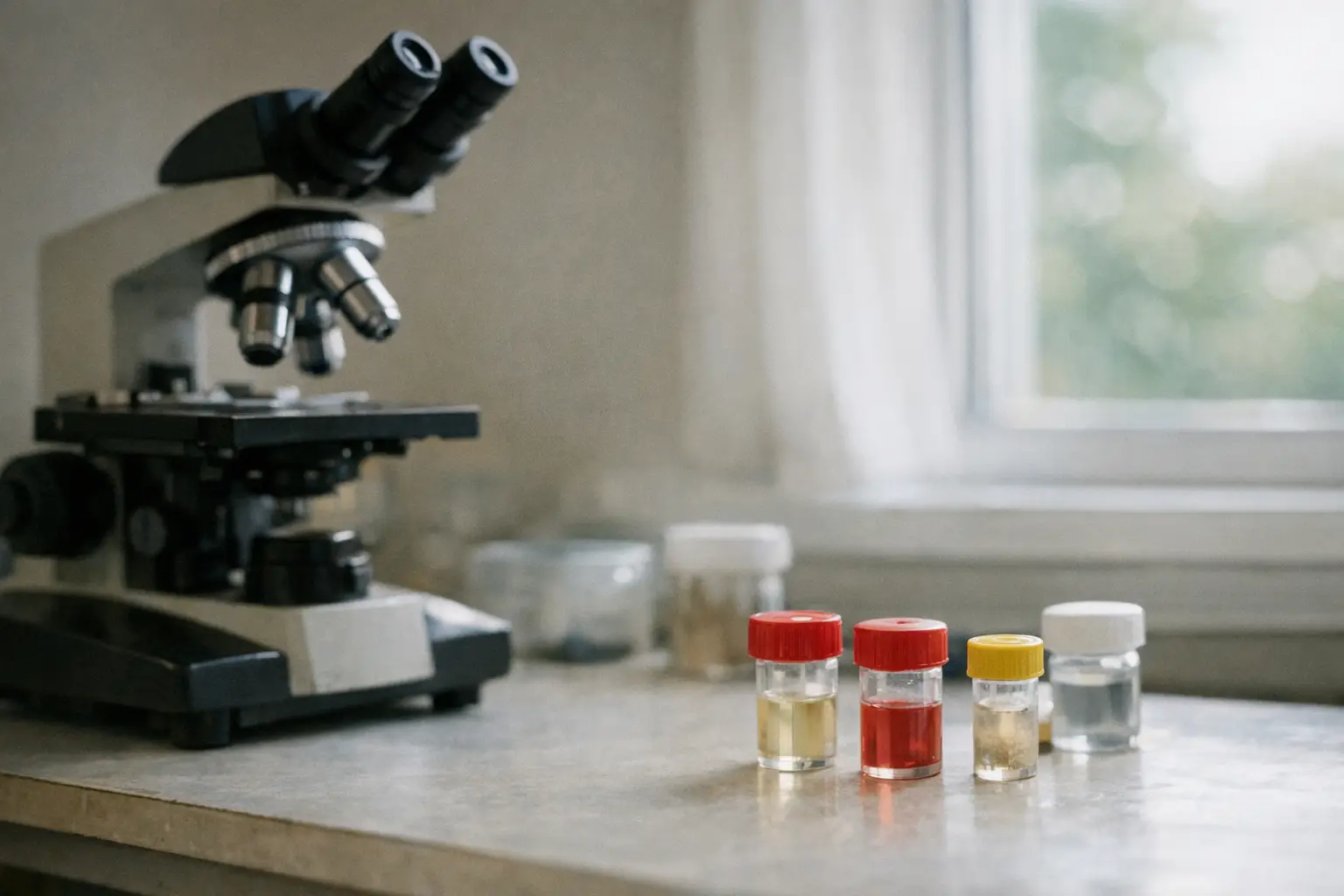
During a biopsy, a small tissue sample is taken and examined under a microscope in the laboratory. It provides clarity when imaging and blood tests don't give a clear answer — for example, in cases of unclear skin changes or lumps. Most often, a brief procedure under local anaesthesia is sufficient.
Typical Areas of Use
- Investigation of abnormal skin changes and moles
- Investigation of lumps, for example in the breast or thyroid gland
- Tissue samples taken during gastroscopy or colonoscopy
- Investigation of unclear findings from imaging
- Confirmation of a diagnosis before treatment
How It Works
- 1Your doctor will explain the procedure to you and apply local anaesthesia to the biopsy site — the injection of the anaesthetic is usually the only thing you will feel.
- 2Depending on the location and the clinical question, the sample is taken using a fine needle, a small punch biopsy instrument, or a scalpel; for deeper tissues, this is often done under ultrasound guidance.
- 3The small wound is closed with a plaster, steri-strips, or a few stitches.
- 4The sample is sent to the laboratory for histological examination; the result is available after several days to approximately two weeks, depending on the analysis, and will be discussed with you.
How to Prepare
- Report any blood-thinning medication in advance — your doctor will decide whether an adjustment is necessary.
- Inform your doctor about any known allergies, particularly to local anaesthetics or plasters.
- For most biopsies, no special preparation is required beyond this.
Side Effects & Risks
- A bruise may develop at the biopsy site or there may be some bleeding afterwards.
- As with any minor procedure, there is a small risk of infection.
- Depending on the location, a small scar may remain.
- Rarely, the sample may not capture the altered tissue precisely — in that case, the biopsy may need to be repeated.
Keep the wound dry and clean for the first few days and rest the affected area according to the instructions from your practice; any stitches will be removed after one to two weeks. A slight pulling sensation and a small bruise are normal. Contact your doctor if the site bleeds heavily, becomes increasingly painful, turns red, feels warm to the touch, or if you develop a fever. Important: Attend the follow-up appointment to discuss the result — only the histological examination provides the actual answer.
Cost & Insurance
Medically justified biopsies and the associated laboratory examination are generally covered by basic insurance; the deductible and co-payment apply as usual. If in doubt, enquire with your health insurer; this information is provided for guidance without guarantee.
Frequently Asked Questions
- Does a biopsy hurt?
- Thanks to the local anaesthesia, you will hardly feel anything during the actual biopsy — usually just the brief prick of the anaesthetic injection and then some pressure. After the anaesthesia wears off, the site may be tender for one to two days.
- How long does it take to get the result?
- Typically several days to approximately two weeks, depending on the analysis. The waiting period is understandably stressful — do feel free to ask when and how you will receive the result.
- Does a biopsy mean there is a suspicion of cancer?
- No, not necessarily. A biopsy is performed whenever a tissue change needs to be precisely classified — very often the result is benign. Its purpose is precisely to provide certainty rather than making assumptions.
- Can I drive afterwards?
- Yes, after a biopsy under local anaesthesia you are generally able to drive immediately. However, if the sample was taken during a procedure with sedation, then the driving restrictions for that procedure apply.
- Will there be a scar?
- With needle and punch biopsies, usually only a tiny mark remains that heals almost invisibly. If a larger piece of skin is removed, a small scar will result — your doctor will choose the technique so that the cosmetic outcome is as good as possible.