
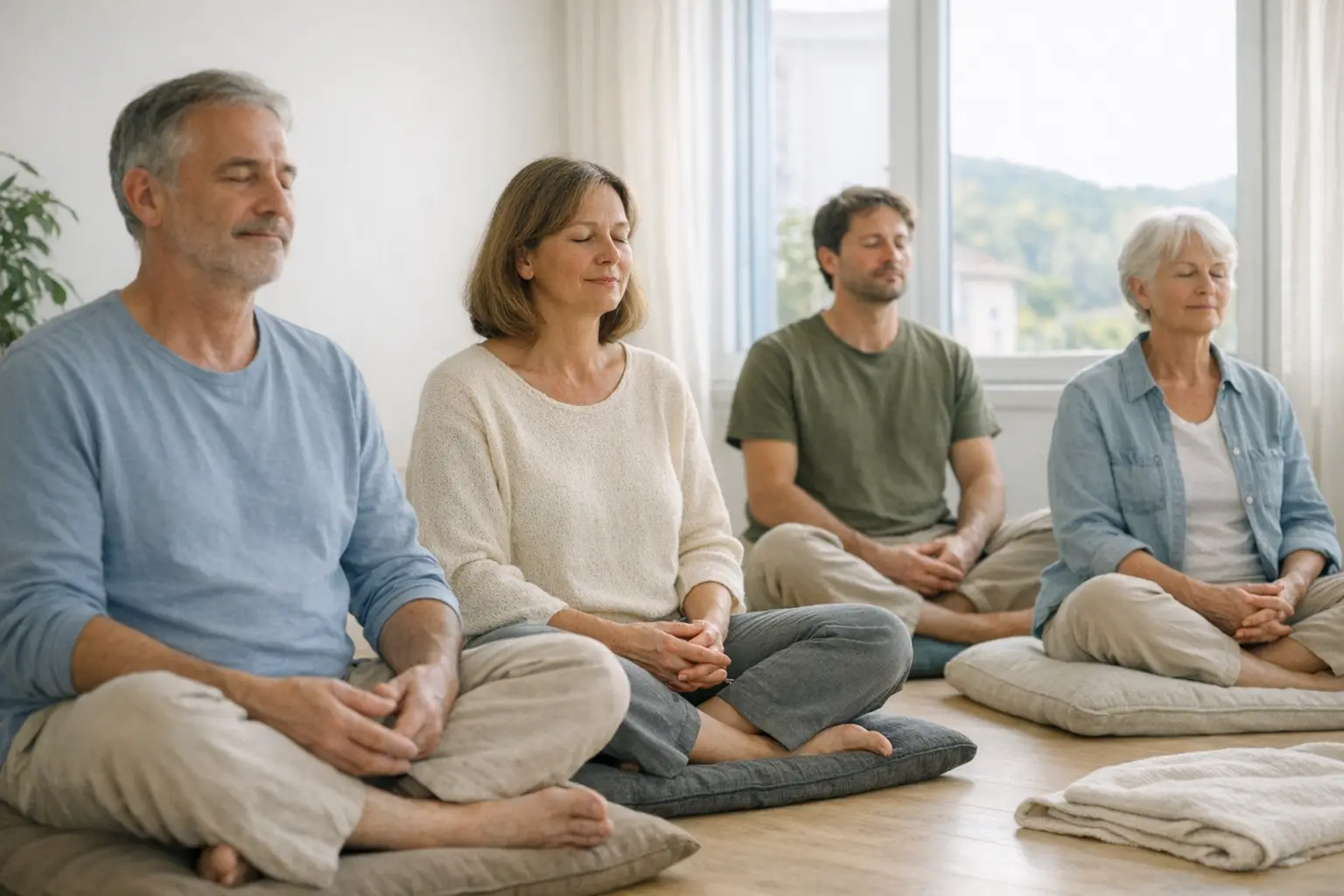
Mindfulness-based therapies train the ability to observe thoughts, feelings and bodily sensations in the present moment without immediately judging or pushing them away. Structured programmes such as MBSR (Mindfulness-Based Stress Reduction) and MBCT (Mindfulness-Based Cognitive Therapy) combine meditation, body exercises and elements of behavioural therapy. They are particularly well supported by evidence for stress-related conditions and for preventing recurrent depressive episodes.
Typical Areas of Use
- Persistent stress and exhaustion
- Prevention of recurrent depressive episodes
- Inner restlessness and rumination
- Sleep problems
- Managing chronic pain
How It Works
- 1At the start, an initial consultation clarifies your situation and your goals — and whether a group programme or integration into individual therapy is more suitable.
- 2Classic programmes comprise eight weekly sessions: you practise guided sitting meditations, mindful body awareness and gentle movement exercises.
- 3The experiences from the exercises are discussed in the group or in individual conversation — for example dealing with rumination, restlessness or pain.
- 4Daily practice at home, usually with audio guidance, is an integral part — the effect arises substantially from this regularity.
- 5At the end you develop a personal plan for how mindfulness can continue in everyday life.
How to Prepare
- Expect daily practice times of around 20 to 45 minutes during the programme — honestly assess whether you currently have the space for this.
- Comfortable clothing makes the body and movement exercises easier.
- If you currently have a mental health condition, discuss beforehand with your therapist whether and in what context the training is appropriate right now.
Side Effects & Risks
- The exercises bring you face to face with what is present internally — unpleasant feelings or restlessness may become more noticeable at first.
- In acute mental health crises or with unprocessed trauma, intensive meditation exercises can be distressing; professional support and an adapted approach are needed here.
- Mindfulness does not replace treatment of an acute condition — it complements it.
- The effect depends strongly on regular practice; without your own practice the benefit remains limited.
After the sessions, many people feel calm yet also reflective — give yourself some space for these impressions. It is normal for restlessness, boredom or resistance to emerge during home practice, and this is part of the training; discuss such experiences in your next session. Contact your course leader or therapist if exercises repeatedly trigger strong anxiety, tension or distressing memories, or if your mood deteriorates markedly — the approach will then be adjusted.

Cost & Insurance
Coverage depends on the setting: If mindfulness is used as part of recognised psychotherapy — for example MBCT with a psychiatrist or, with a doctor's referral, with a psychological psychotherapist — the basic insurance usually covers it, with Franchise and co-payment as usual. Standalone mindfulness and MBSR courses, on the other hand, are generally not covered by the basic insurance; many supplementary insurance policies contribute toward recognised courses as part of health promotion. This is meant as general guidance without guarantee — if in doubt, please ask your insurer.
Frequently Asked Questions
- Is mindfulness training scientifically supported?
- For structured programmes such as MBSR and MBCT there is good evidence, particularly for stress-related conditions and for preventing recurrent depressive episodes. For other applications the evidence varies in strength — reputable providers do not promise miracles.
- Do I need to know how to meditate or be particularly 'spiritual'?
- No. Mindfulness-based therapies are designed to be philosophically neutral and require no prior experience. The exercises are guided step by step — restlessness and wandering thoughts are explicitly part of the process.
- How much do I have to practise at home?
- In classic programmes it is around 20 to 45 minutes daily with audio guidance. That sounds like a lot, but it is a core component — the effect arises substantially from the regularity.
- Does mindfulness also help with acute depression?
- During an acute depressive episode, pure mindfulness training is usually not the first choice of treatment. MBCT is particularly well supported by evidence for preventing relapses after recovered episodes — your therapist will assess what is appropriate in your situation.
- What does an MBSR course cost and will my insurer pay?
- Eight-week courses often cost several hundred francs depending on the provider. Basic insurance generally does not cover independent courses; however, many supplementary insurance policies contribute towards recognised offerings — check with your insurer before enrolling.