
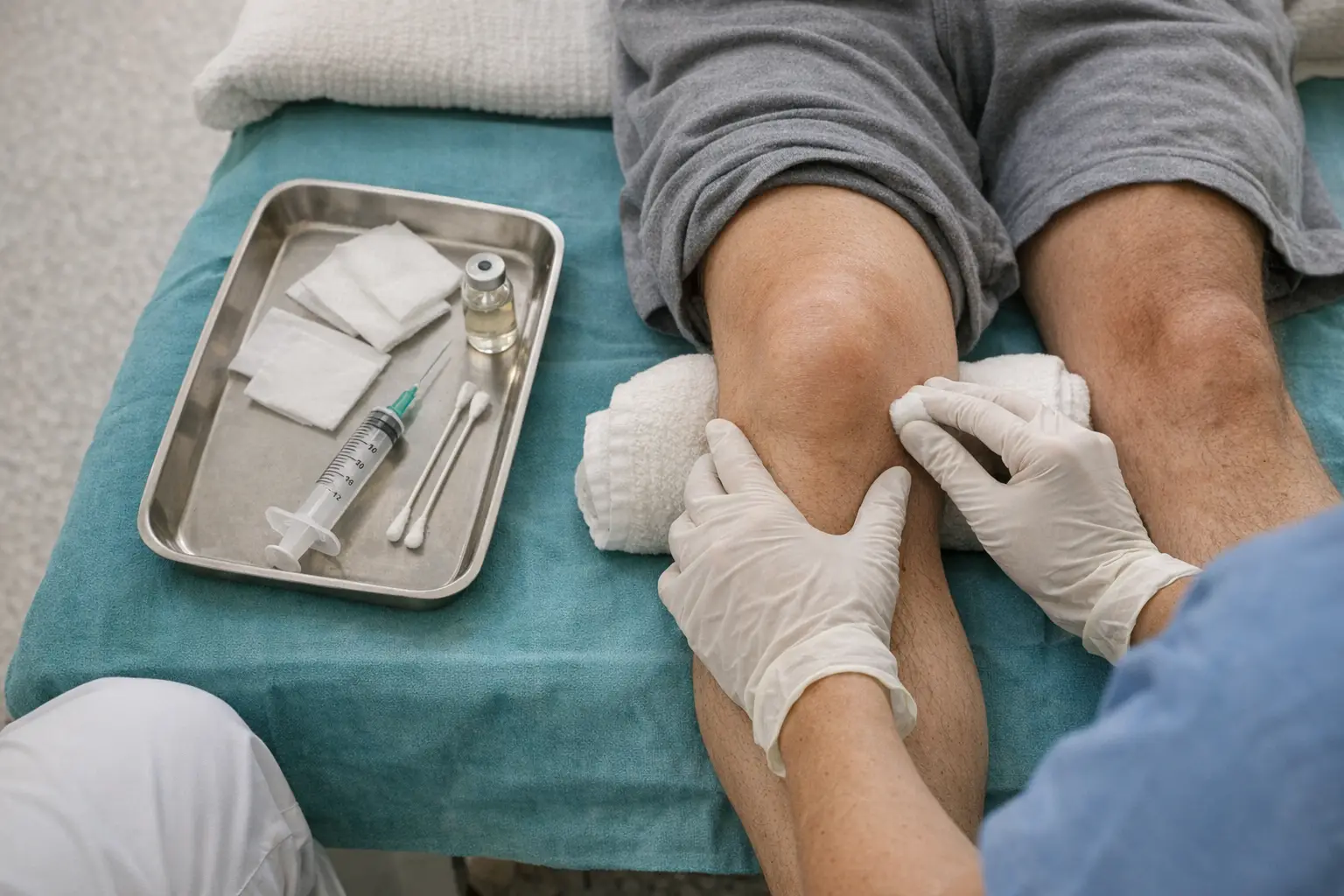
During a joint aspiration, your doctor inserts a fine needle into a joint — usually to drain accumulated fluid and examine it, sometimes also to inject medication at the same time. The procedure often provides immediate relief to a swollen, tense joint and delivers valuable clues about the cause: for example, inflammation, gout or an infection.
Typical Areas of Use
- Swollen joint with effusion, e.g. in the knee
- Investigation of unclear joint inflammation
- Suspected gout or pseudogout
- Suspected joint infection
- Pressure relief for a tense, painful joint
How It Works
- 1Your doctor examines the joint and determines the puncture site — for deeper joints such as the hip, with the help of ultrasound.
- 2The skin is thoroughly disinfected and covered with sterile drapes; if desired or for sensitive areas, local anaesthetic is applied.
- 3The joint is punctured with a fine needle and the fluid is drawn off with the syringe — this often provides immediately noticeable relief to the joint; if needed, medication is injected in the same step.
- 4Depending on the clinical question, the fluid obtained is sent to the laboratory, for example to test for crystals or bacteria; the puncture site is covered with a plaster and light pressure bandage.
How to Prepare
- Inform your doctor about blood thinners, allergies and artificial joints.
- Wear clothing that allows good access to the affected joint.
- Report fever or skin changes over the joint before the appointment — they influence the procedure.
Side Effects & Risks
- Bruising or residual pain at the puncture site
- Re-accumulation of effusion if the underlying cause persists
- Rarely, a joint infection — strict sterile conditions minimise this risk
- Very rarely, injury to blood vessels or nerves in the vicinity
- Brief feeling of dizziness or weakness during the procedure (circulatory reaction)
Rest the joint for the remainder of the day and avoid intensive sport for two to three days; everyday activities are usually possible without problems. Slight residual pain or a small bruise at the puncture site are normal. Contact your doctor immediately if the joint swells up again significantly, becomes increasingly painful, turns red or feels hot, or if fever and chills occur — a joint infection is rare but must be treated quickly.
Cost & Insurance
A medically indicated joint aspiration — for diagnostic purposes or relief — is covered by the basic insurance, as are the associated laboratory tests of the joint fluid; the deductible and co-payment apply as usual. Since the aspiration is performed directly by a doctor, no separate prescription is needed; depending on your insurance model, the route to a specialist may go through your general practice — if in doubt, ask your insurer.
Frequently Asked Questions
- Does a joint aspiration hurt?
- The puncture is comparable to a blood draw, but may be somewhat more noticeable at the joint — a brief pressure or pulling sensation is normal. Local anaesthetic is applied on request. Many people even experience the draining of the effusion as immediate relief.
- How quickly will I feel an improvement?
- If a tense joint is relieved, the pressure pain often subsides immediately. Whether the improvement lasts depends on the cause — if the effusion re-accumulates, the underlying condition is treated specifically.
- What happens to the joint fluid?
- If appropriate to the clinical question, it is examined in the laboratory: colour, cell count, crystals and bacteria provide clues about osteoarthritis, gout, rheumatic inflammation or infection. Your doctor will discuss the results with you at the follow-up appointment.
- How great is the risk of infection?
- Very small: thanks to strict disinfection and sterile materials, joint infection following aspiration is a rarity. It is important that you take warning signs such as increasing swelling, redness or fever seriously and report them promptly.
- Will I be able to drive afterwards?
- Usually yes. If a leg was punctured or local anaesthetic was used, wait until you can safely bear weight on and feel the joint again before driving — if in doubt, arrange for someone to accompany you to the appointment.