
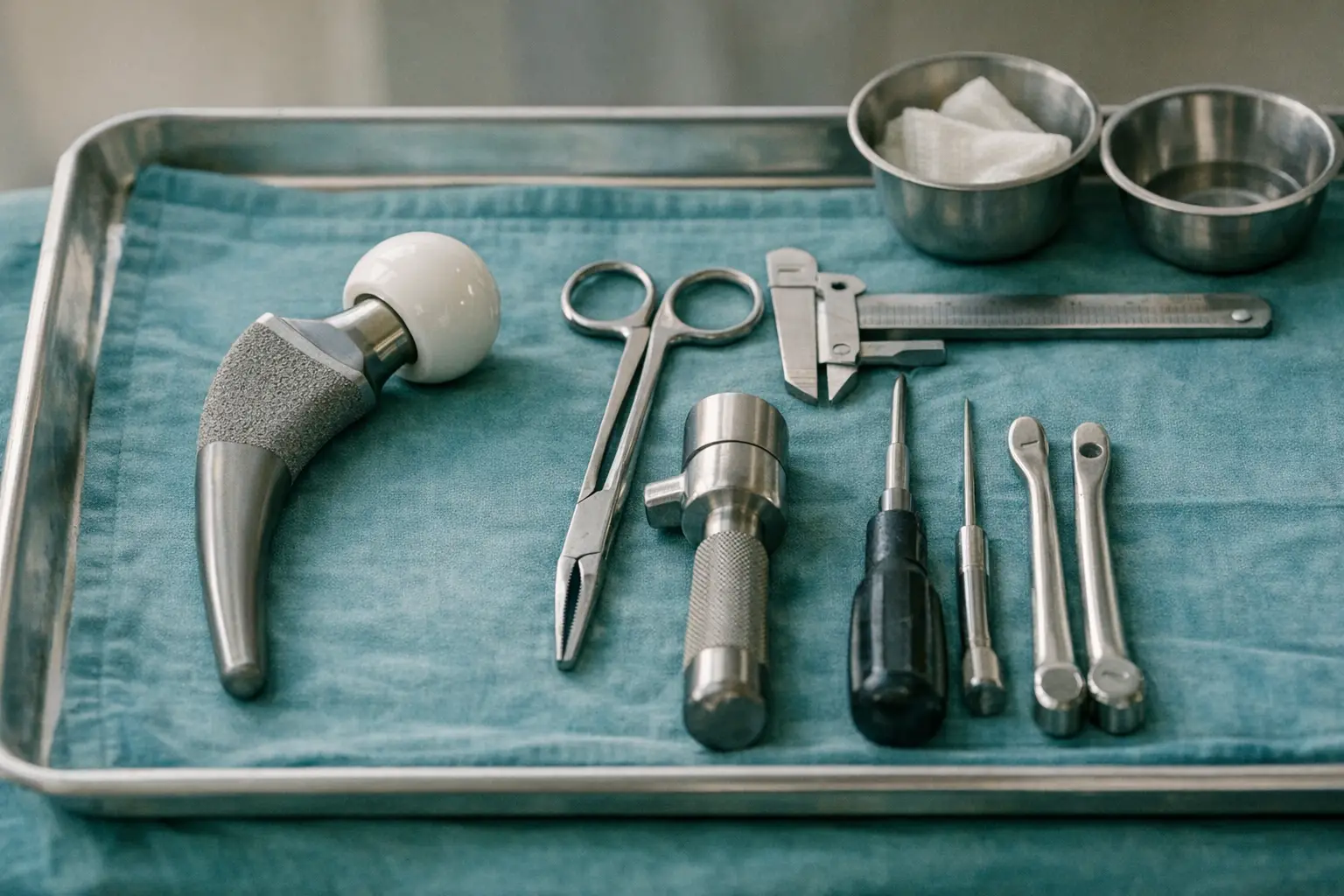
When the hip joint has become so severely worn by arthritis that pain dominates everyday life and walking, sleeping or tying your shoes becomes agony, an artificial hip joint can significantly restore your quality of life. During the procedure, the worn joint surfaces are replaced with a prosthesis made of metal, ceramic and plastic — one of the most successful procedures in modern medicine.
Typical Areas of Use
- Advanced hip arthritis
- Pain in hip and groin during activity and at rest
- Increasing limitation when walking and in daily life
- Hip damage following fractures or circulatory disorders of the femoral head
How It Works
- 1Before the procedure, a planning consultation, current X-rays and an anaesthesia consultation take place; the prosthesis is planned individually according to your anatomy.
- 2The operation is performed under general or regional anaesthesia: the worn femoral head is removed, the acetabulum is prepared and the prosthetic components are inserted.
- 3On the day of surgery or the following day, you stand up for the first time with the support of physiotherapy — early mobilisation is part of the concept.
- 4After a few days in hospital, you are discharged home or to a rehabilitation facility, where strength and gait are specifically built up.
How to Prepare
- Pre-existing conditions, medications and blood thinners are discussed during the anaesthesia consultation; dental or other infections should be treated before the procedure.
- If possible, train your strength and mobility in advance — good baseline fitness makes rehabilitation easier.
- Prepare your home: remove tripping hazards, place frequently used items within easy reach, organise aids such as a reaching tool if necessary.
- Clarify early on whether rehabilitation or support at home is planned after hospital discharge.
Side Effects & Risks
- Bruising, wound healing problems or infections — prosthetic infections are rare but must be treated consistently.
- Thrombosis and embolism; you will receive temporary anticoagulant medication as prevention.
- Rarely, dislocation of the new hip, especially in the first few weeks.
- Leg length discrepancies or nerve irritation are rare and usually well treatable.
- Over the years the prosthesis may loosen — but modern implants often last 15 to 20 years or longer.
During the first weeks you will walk with crutches, do your physiotherapy exercises diligently and follow the movement guidelines you are given — such as avoiding certain rotational movements initially. Swelling and a feeling of warmth around the scar are normal at first. Contact your doctor promptly if the wound is weeping or severely reddened, fever or chills occur, pain suddenly increases, the leg feels shortened or twisted, or the calf swells painfully. In the long term: inform your doctor about the prosthesis in case of major dental or other infections.

Cost & Insurance
Hip replacement is covered by basic insurance when medically indicated, including hospital stay in the general ward of your canton of residence; the deductible and co-payment apply as usual. Medically prescribed inpatient rehabilitation requires cost approval from your insurer, but is then also covered by basic insurance. For free choice of hospital throughout Switzerland or semi-private/private ward, you need a corresponding supplementary insurance. If in doubt, check with your insurer — no guarantee.
Frequently Asked Questions
- When is the right time for a hip replacement?
- When pain and limitations significantly impair your daily life and quality of life despite exhausted conservative treatment — physiotherapy, painkillers, injections. You determine the timing together with your orthopaedic surgeon; the X-ray alone does not decide.
- How long does it take until I can walk normally again?
- You take your first steps on the day of surgery or the following day. After four to six weeks, many people walk without crutches, and after about three months daily life is usually manageable again — progress varies individually.
- How long does a hip prosthesis last?
- Modern prostheses often last 15 to 20 years and frequently longer. Should the implant loosen over time, a replacement is possible.
- Am I still allowed to do sports with a hip prosthesis?
- Yes — hiking, cycling, swimming or cross-country skiing are explicitly encouraged. Sports with high impact and fall risk are rather discouraged; discuss your wishes with your orthopaedic surgeon.
- When am I allowed to drive a car again?
- Usually after about four to six weeks, when you can safely bear weight on the leg and brake firmly in an emergency. Clarify the timing at your follow-up appointment.
- Do I need rehabilitation after hospital discharge?
- Many benefit from inpatient or outpatient rehabilitation, others do their physiotherapy from home. What makes sense for you is planned with you before the procedure and depends on your situation at home.