
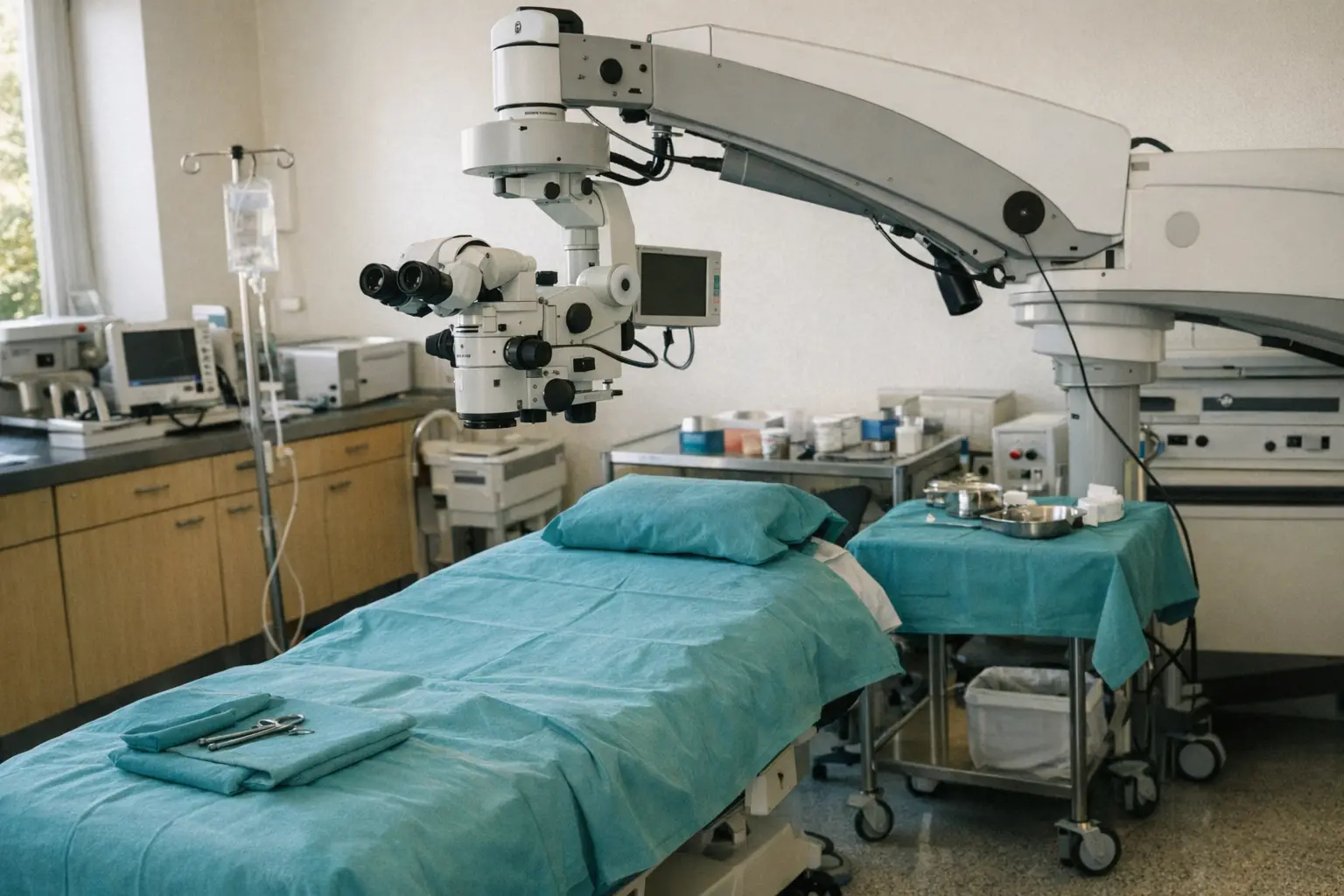
With cataracts, the eye's natural lens becomes cloudy—the world appears increasingly blurred, low in contrast, or glaring. During cataract surgery, the clouded lens is replaced with a clear artificial lens. It is one of the most common and well-established procedures, and it is almost always performed on an outpatient basis.
Typical Areas of Use
- Increasingly blurred or cloudy vision
- Sensitivity to glare, for example when driving at night
- Faded colours and poorer contrast vision
- Frequently changing eyeglass prescriptions
How It Works
- 1Beforehand, your eye is precisely measured so that the power of the artificial lens can be individually calculated; you will discuss any open questions about lens selection with your ophthalmologist.
- 2On the day of surgery, your eye is anaesthetised with drops and the pupil is dilated—general anaesthesia is usually not necessary.
- 3Through a tiny incision, the clouded lens is broken up with ultrasound, removed by suction, and the folded artificial lens is inserted, where it unfolds by itself.
- 4The incision is so small that it usually heals on its own without sutures; the eye is covered with a protective bandage or a clear shield.
- 5After a brief period of observation, you may go home accompanied; the second eye—if necessary—is usually operated on a few weeks later.
How to Prepare
- Discuss with your doctor which of your medications you should take normally on the day of surgery—you are usually allowed a light breakfast; you will receive precise instructions from the surgical team.
- Arrange for someone to accompany you: with a covered eye, you may not drive yourself.
- Avoid eye make-up and facial creams on the day of surgery.
- If possible, obtain the prescribed eye drops for post-operative care in advance.
Side Effects & Risks
- Temporary foreign-body sensation, watering, or slight redness during the first few days.
- Rarely, inflammation or infections in the eye, which must be treated promptly.
- Posterior capsule opacification—a clouding of the lens capsule months to years later—is possible and can be treated on an outpatient basis with a laser.
- Very rarely, retinal problems or persistent deterioration of vision.
- The standard lens does not usually make glasses completely unnecessary, for example for reading.
During the first few weeks, apply the prescribed eye drops consistently and attend the scheduled follow-up appointments. Do not rub your eye, avoid swimming pools, saunas, and heavy physical exertion at first, and protect your eye at night as instructed. A slight foreign-body sensation is normal. Contact your doctor immediately if your vision suddenly worsens, severe pain occurs, your eye becomes very red, or you see flashes of light and many new floaters—such signs require prompt ophthalmological evaluation.

Cost & Insurance
The medically indicated cataract surgery with a standard lens is covered by the mandatory basic insurance; Franchise and co-payment apply as usual. If you would like a special lens — for example a multifocal lens intended to additionally replace reading glasses — the additional cost is generally not covered by the insurance fund and is offered transparently in advance. If in doubt, please ask your insurance fund — without guarantee.
Frequently Asked Questions
- Does cataract surgery hurt?
- No, thanks to the anaesthetic drops you will at most feel pressure or touch. Afterwards, too, severe pain is atypical—a foreign-body sensation for a few days, however, is normal.
- Will I be awake during the surgery?
- Yes, you are usually awake, but your eye is anaesthetised and you will hardly see anything of the procedure itself. If you are very anxious, the team can offer you a mild sedative.
- How quickly will I see well again?
- Many notice a clear improvement after just one or two days; the final result develops over a few weeks. Any new glasses will only be fitted after that.
- When may I drive again after the surgery?
- Only when your ophthalmologist confirms at a follow-up appointment that your visual acuity is sufficient again—often after a few days to a few weeks. On the day of surgery itself, driving is not permitted.
- What does the surgery cost?
- With a standard lens, the mandatory basic insurance covers the costs, less Franchise and co-payment. Additional private costs are only incurred for special lenses with extra functions, and these will be quoted to you in advance.
- Can cataracts come back?
- The artificial lens itself does not become cloudy again. What is possible is so-called posterior capsule opacification, a clouding of the lens capsule—this can be treated in a few minutes on an outpatient basis with a laser.