
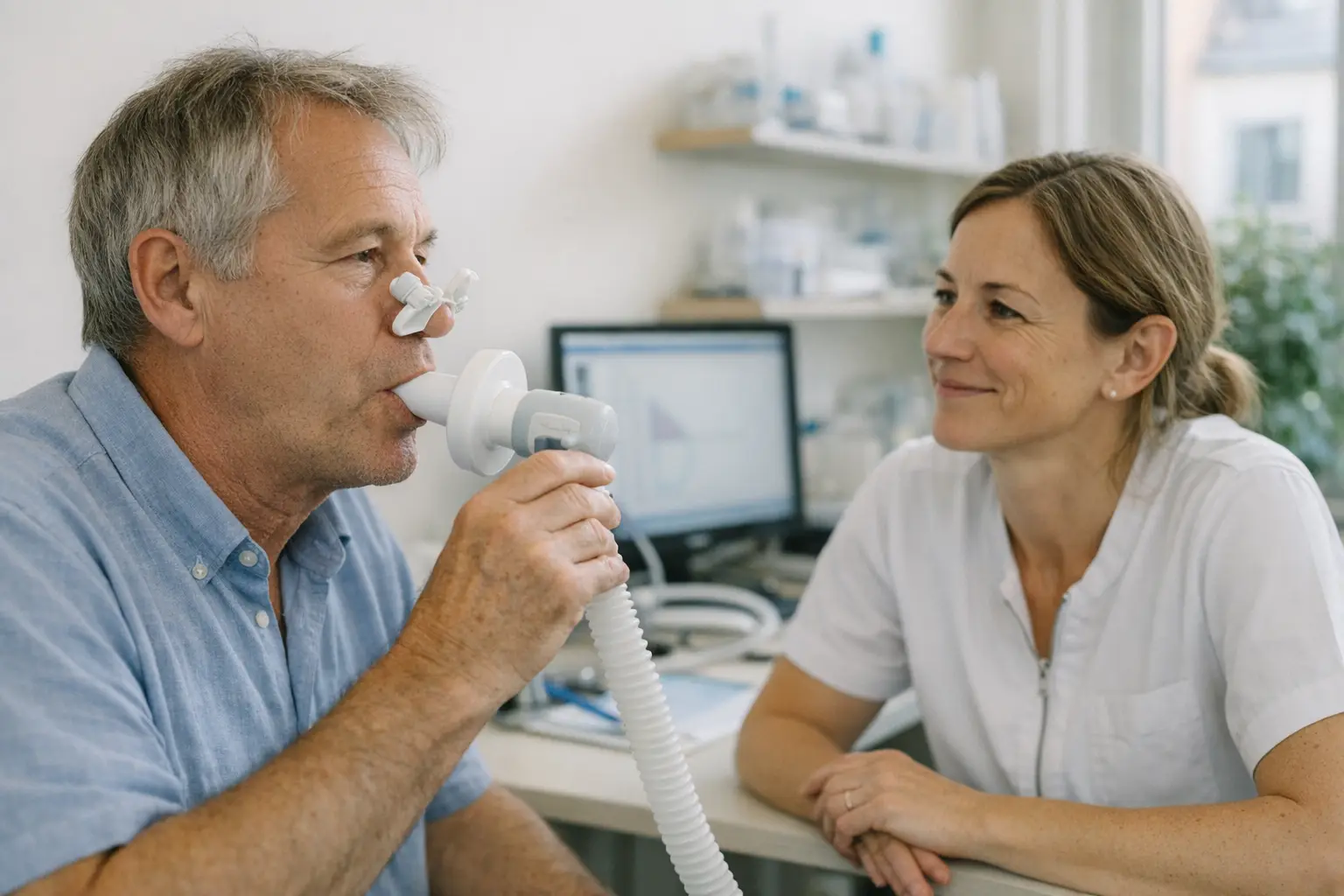
The pulmonary function test (spirometry) measures how much air you can breathe in and out and how quickly this happens. It is the most important examination when asthma or a chronic lung disease is suspected — painless, quick, and available directly in many general practice surgeries.
Typical Areas of Use
- Investigation of chronic cough
- Investigation of breathlessness and shortness of breath
- Diagnosis and monitoring of asthma
- Investigation when COPD is suspected, particularly in smokers
- Assessment of the lungs before operations
How It Works
- 1You sit upright, receive a nose clip, and breathe through a mouthpiece into the measuring device.
- 2The healthcare professional guides you through the breathing manoeuvres: breathe calmly, then inhale as deeply as possible and exhale as forcefully and completely as you can.
- 3The manoeuvres are repeated several times so that a reliable best result is obtained — the guidance helps you to get the maximum out of it.
- 4Depending on the question being investigated, you then inhale a bronchodilator medication and the measurement is repeated — this shows whether the airways can be opened, which is typical of asthma.
- 5Your doctor discusses the curves and results directly with you.
How to Prepare
- Wear comfortable clothing that does not constrict your abdomen or chest.
- Avoid heavy meals, smoking, and major physical exertion immediately before the test.
- Whether you should pause your inhalation medications before the test will be explained by the surgery — do not change anything without this information.
Side Effects & Risks
- The forced breathing manoeuvres can briefly trigger dizziness, coughing, or a feeling of tightness — this passes within seconds to minutes.
- Serious risks with spirometry are virtually non-existent.
- The result depends heavily on your cooperation: only several valid attempts produce reliable results.
After the test, you can return to your everyday activities right away; a brief feeling of dizziness immediately after the breathing manoeuvres usually passes quickly if you sit down. Discussing the results is important: they show whether and how narrowed your airways are, and whether treatment is needed or should be adjusted. Arrange an appointment soon and don't wait if breathlessness during everyday activities increases, if you have coughing fits at night, or if you find yourself needing your inhalers more and more often. If you have breathlessness at rest, or if you can only speak in single words: call 144 immediately.

Cost & Insurance
A physician-ordered pulmonary function test is generally covered by basic insurance; Franchise and co-payment apply as usual. Many general practices perform spirometry themselves; for extended measurements, the doctor refers you to a pulmonologist. If in doubt, ask your health insurer; this information is for guidance only, without guarantee.
Frequently Asked Questions
- Does a pulmonary function test hurt?
- No. You merely breathe through a mouthpiece — at most the forceful exhalation manoeuvres are strenuous and can briefly trigger dizziness or coughing.
- How long does the test take?
- About 15 to 30 minutes. If there is additional testing of how the lungs respond to a bronchodilator medication, around 15 minutes of waiting time and a second measurement are added.
- What is the difference between asthma and COPD in the test?
- In asthma, the narrowing of the airways can typically be significantly improved by a bronchodilator medication; in COPD only to a limited extent. This is precisely what the second measurement after inhalation checks — together with your medical history, this leads to the diagnosis.
- Should I use my inhalers before the test?
- That depends on the question being investigated: for some measurements the medications should be paused beforehand, for monitoring appointments they should not. Follow the surgery's instructions and do not stop anything of your own accord.
- Can I do the test even with a cold?
- Better not — an acute infection can temporarily worsen the results and distort the outcome. Contact the surgery; often the appointment is postponed by one to two weeks.