
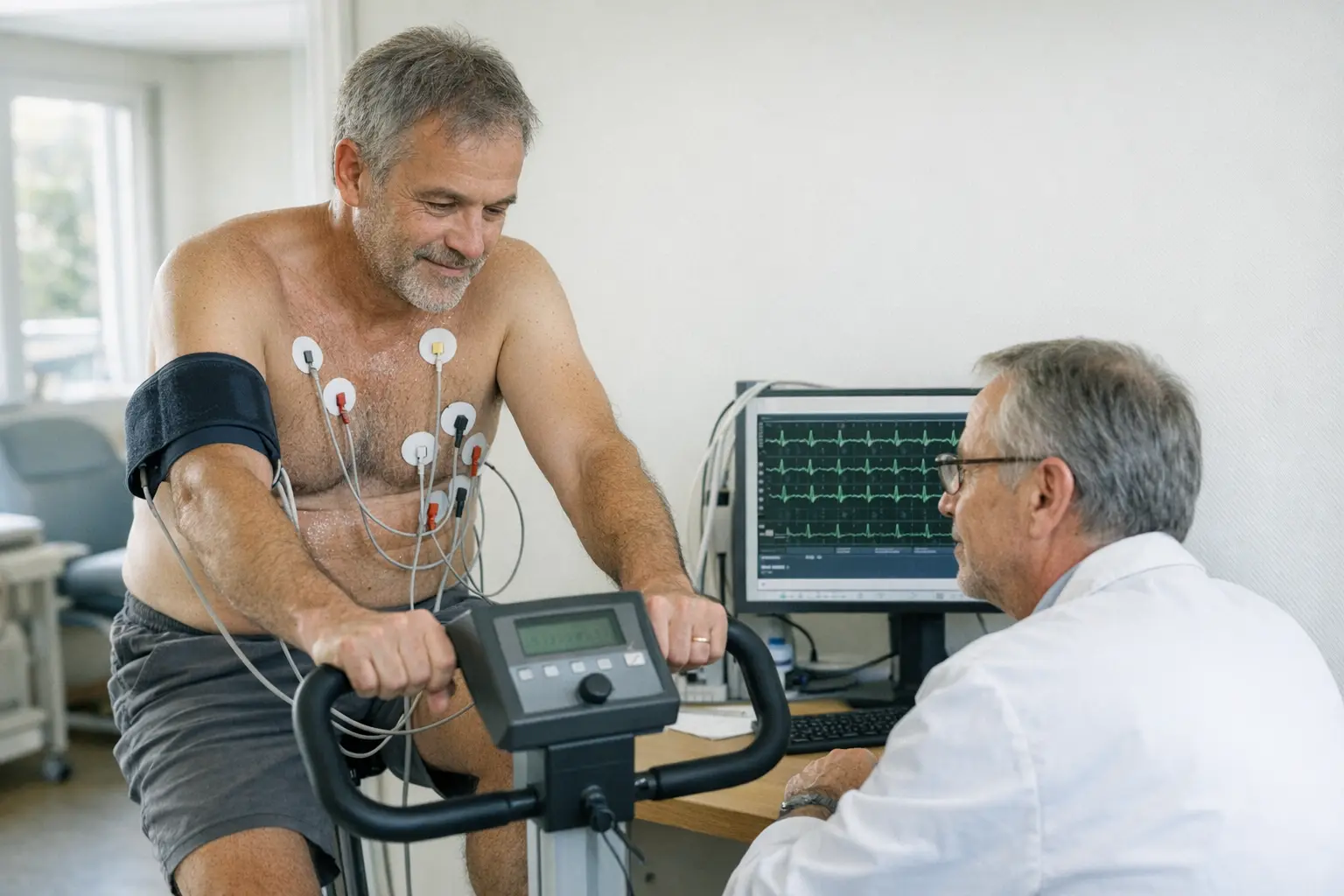
During an exercise ECG (ergometry), your heart is monitored under controlled physical exertion — usually on a bicycle ergometer. This reveals how your heart, circulation and blood pressure respond to exertion, which is often not apparent at rest.
Typical Areas of Use
- Investigation of chest pain or pressure sensation during exertion
- Suspected impaired blood flow in the coronary arteries
- Assessment of blood pressure and pulse under exertion
- Evaluation of physical performance capacity
- Follow-up monitoring after a cardiac event or procedure
How It Works
- 1As with the resting ECG, electrodes are attached to your chest, and a blood pressure cuff is placed on your arm.
- 2You pedal on the bicycle ergometer; the resistance is increased gradually every few minutes.
- 3Throughout the entire time, your ECG, pulse and blood pressure are continuously monitored; you report if any symptoms occur — the examination can be stopped at any time.
- 4After the exertion phase, there is a monitored recovery period of several minutes until your pulse and blood pressure have normalised.
- 5Your doctor evaluates the traces and discusses the result with you.
How to Prepare
- Bring comfortable sports clothing and suitable shoes with you.
- Do not eat a heavy meal in the two hours before your appointment and avoid nicotine immediately beforehand.
- Take your medication as usual, unless your doctor has agreed something different with you — certain heart medications are sometimes paused for the examination.
- Bring a current list of your medications with you.
Side Effects & Risks
- Muscle soreness or temporary exhaustion after the exertion are normal.
- Rarely, cardiac arrhythmias, blood pressure irregularities or circulatory problems occur during exertion — you are continuously monitored and the examination is stopped immediately if warning signs appear.
- The diagnostic value is limited: an unremarkable exercise ECG does not reliably rule out heart disease, an abnormal one does not prove it — further investigations often follow.
Give yourself a moment's rest after the examination and have something to drink; you can shower normally afterwards. Mild muscle soreness is harmless. Contact your doctor immediately or call emergency services on 144 if chest pain, shortness of breath, dizziness or palpitations occur again after the examination.

Cost & Insurance
An exercise ECG ordered by a doctor is generally covered by basic insurance; the deductible and co-payment apply as usual. It is usually performed by a cardiologist or GP with the appropriate equipment. If in doubt, check with your health insurer; this information is for guidance only and without guarantee.
Frequently Asked Questions
- How strenuous is an exercise ECG?
- You will be challenged, but in a controlled way: the resistance increases in stages until you reach an appropriate level of exertion for you. You can say at any time if it becomes too much — the examination can be stopped immediately.
- Is an exercise ECG dangerous?
- The risk is low. You are monitored throughout the entire examination, and the team is prepared for rare complications such as arrhythmias. This is precisely why the exertion takes place under medical supervision and not in a fitness centre.
- What should I wear?
- Comfortable sports clothing and trainers or sturdy shoes. Your upper body must be freely accessible for the electrodes; you can change on site.
- Should I take my medication beforehand?
- Generally yes — unless your doctor has agreed something different with you. Certain medications that slow the pulse are sometimes deliberately paused for the examination. Never change your medication on your own initiative.
- Will I be fit to drive afterwards?
- Yes, as a rule you can drive home normally after the recovery phase. Simply wait until your pulse and circulation have returned to normal.