
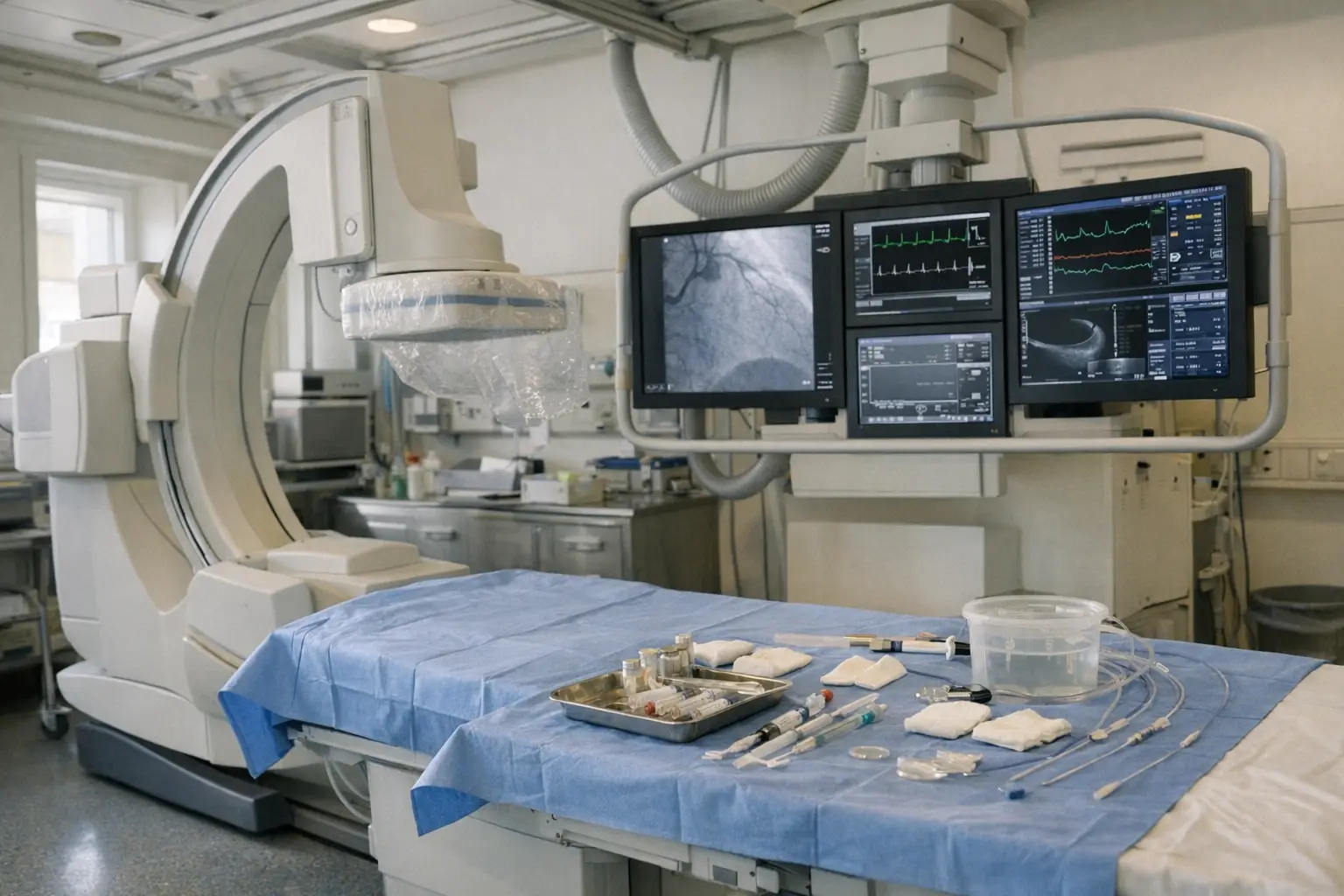
During a cardiac catheterization procedure, the cardiologist advances a thin, flexible tube through an artery in your wrist or groin up to your heart. Contrast medium is used to visualize the coronary arteries — and narrowed areas can often be treated during the same procedure with a balloon and stent. This way, cardiac catheterization serves as both diagnosis and treatment in one.
Typical Areas of Use
- Investigation of narrowed coronary arteries
- Chest pain or pressure sensation during exertion (angina pectoris)
- Widening of narrowed vessels with balloon and stent
- Emergency treatment for heart attack
- Investigation of unexplained heart failure or valve disorders
How It Works
- 1After informed consent and local anesthesia, the artery at your wrist or in your groin is punctured — you remain awake during this, but can receive a mild sedative if you wish.
- 2The catheter is advanced under X-ray guidance up to your heart; you typically will not feel this, as the vessels have no pain receptors on the inside.
- 3Contrast medium makes the coronary arteries visible on the screen; you may experience a brief warm sensation.
- 4If a significant narrowing is found, it can often be dilated directly with a small balloon and stabilized with a stent — a fine mesh tube.
- 5After the procedure, the puncture site is treated with a pressure bandage or closure device; depending on the findings, you may go home the same day or stay overnight for monitoring.
How to Prepare
- You will usually arrive fasting; you should discuss your medications — especially blood thinners and diabetes medications — with your doctor beforehand.
- Report any known allergies, particularly to contrast medium, as well as any impaired kidney function.
- Arrange for someone to accompany you home; you may not drive yourself on the day of the examination.
- Bring your medication list and any previous cardiac reports with you.
Side Effects & Risks
- Bruising at the puncture site — common and usually harmless.
- Rarely, allergic reactions to the contrast medium or temporary strain on the kidneys.
- Rarely, cardiac arrhythmias during the examination, which the team will immediately recognize and treat.
- Very rarely, serious complications such as vascular injuries, heart attack, or stroke — the risk is low for planned examinations and will be discussed with you beforehand.
After the procedure, the puncture site is monitored for a few hours; if access was through the groin, bed rest is required at first, while for the wrist, the arm wears a pressure bandage. Take it easy for a few days, avoid heavy lifting, and drink enough fluids to help eliminate the contrast agent. A small bruise is normal. Get in touch immediately if the puncture site swells significantly, pulsates, or bleeds again, if the hand or leg becomes cold or numb, if fever occurs — or, in the case of renewed chest pain and shortness of breath, dial the emergency number 144 directly. If a stent was inserted, reliably taking the blood-thinning medication is crucial — never stop taking it without consulting your doctor first.

Cost & Insurance
Cardiac catheterization examinations and treatments are covered by basic insurance when medically indicated, including any stents and monitoring; the deductible and co-payment apply as usual. Referral is made through your general practitioner or cardiologist, or directly in an emergency. Any subsequently prescribed outpatient cardiac rehabilitation is also covered by basic insurance. If in doubt, clarify details with your insurance company — no guarantee.
Frequently Asked Questions
- Does cardiac catheterization hurt?
- The small prick for the local anesthesia is briefly uncomfortable; you normally will not feel the advancement of the catheter itself. With the contrast medium, you may experience a brief warm sensation passing through your body — this is harmless.
- Will I be awake during the examination?
- Yes, you will be awake and able to speak with the team — this is actually helpful. If you are anxious, you can receive a mild sedative if you wish.
- What is a stent and does it stay in the body forever?
- A stent is a fine metal mesh that keeps a dilated vessel open. It grows into the vessel wall and remains there permanently — you will not feel it.
- How long do I need to take blood thinners after a stent?
- A combination of anticoagulant medications is typically prescribed for several months, followed by a single medication long-term. Your cardiologist will determine the exact regimen — it is important not to stop anything on your own.
- When can I return to work and drive after the procedure?
- After an uncomplicated examination, usually after one to a few days; after stent placement, individually somewhat later. You may not drive on the day of the examination itself — your doctor will tell you when you can.
- Are there alternatives to cardiac catheterization?
- For diagnostic purposes alone, there are less invasive procedures depending on the question, such as stress tests or computed tomography of the coronary arteries. However, only catheterization can treat — that is, dilate and place stents; your cardiologist will decide with you what makes sense in your case.