
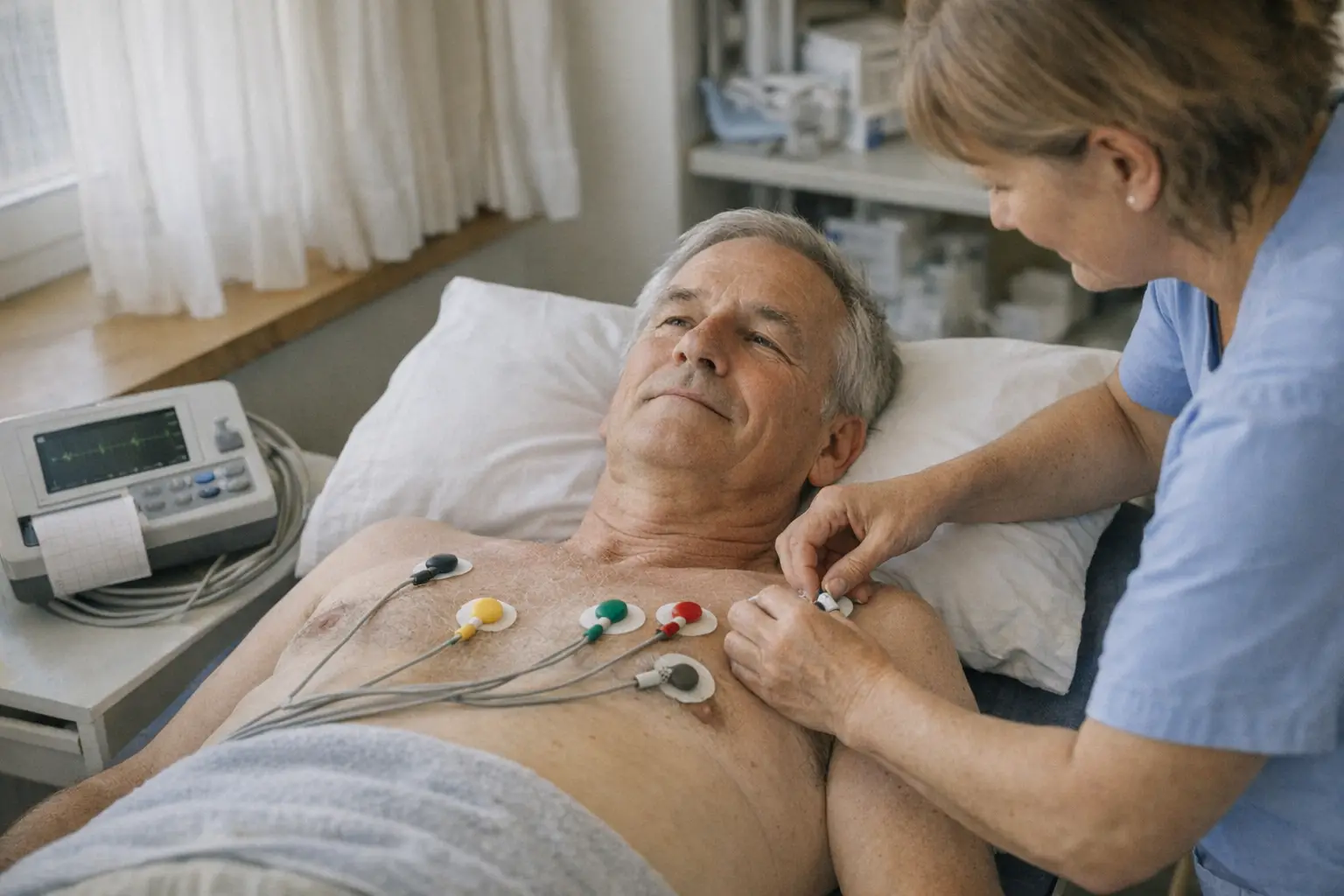
An electrocardiogram (ECG) records the electrical activity of the heart via electrodes on the skin — completely painless and in just a few minutes. It shows whether the heart is beating regularly and provides clues about rhythm disturbances or circulatory problems.
Typical Areas of Use
- Investigation of palpitations and irregular heartbeat
- Investigation of chest pain
- Investigation after fainting or dizziness
- Monitoring in case of high blood pressure
- Heart check as part of a preventive examination
How It Works
- 1You undress your upper body and lie down relaxed on the examination table.
- 2The healthcare professional attaches electrodes to your chest, arms and legs — this is completely painless.
- 3During the recording you lie still for a few seconds to a few minutes and breathe normally.
- 4The trace is immediately printed out or displayed digitally; your doctor evaluates it and usually discusses the result with you directly. If symptoms are unclear, a long-term ECG over 24 hours or longer may be useful as a supplement.
How to Prepare
- No special preparation is necessary; practical clothing that can be easily removed from the upper body is helpful.
- On the day of the examination, avoid using greasy creams on your chest if possible, so that the electrodes adhere properly.
Side Effects & Risks
- The ECG is risk-free — it only measures, no current is emitted.
- Occasionally the adhesive electrodes cause temporary mild skin redness.
- A resting ECG is a snapshot: it can miss rhythm disturbances that only occur intermittently — in that case a long-term ECG is helpful.
After an ECG there is nothing to observe — you can return to your daily routine immediately. What matters is the interpretation by your doctor: an unremarkable ECG is reassuring, but does not rule out every heart condition. Contact your doctor immediately or call the emergency number if severe chest pain, shortness of breath or fainting occur again — regardless of your last ECG result.

Cost & Insurance
An ECG ordered by a doctor is generally covered by basic insurance; the deductible and co-payment apply as usual. This also applies to long-term ECGs when there is a medical indication. If in doubt, check with your health insurance company; this information is for guidance only and without guarantee.
Frequently Asked Questions
- Does an ECG hurt?
- No, not at all. Only electrodes are attached that measure the heart's electrical signals — you don't feel anything. At most, removing the adhesive pads pinches briefly.
- How long does an ECG take?
- The recording itself takes less than a minute to a few minutes. Including dressing and undressing, you are usually done within a quarter of an hour.
- What is a long-term ECG?
- You wear a small recording device for 24 hours or several days during your daily routine. This allows rhythm disturbances to be detected that only occur occasionally and would remain undetected in a short resting ECG.
- Can an ECG rule out a heart attack?
- Not completely. The ECG provides important clues, but depending on the situation is combined with a blood test and further investigations. In case of acute severe chest pain, always: call the emergency number 144 immediately.
- Do I need to fast for an ECG?
- No, you can eat and drink normally beforehand. You also take your medication as usual, unless your doctor tells you otherwise.