
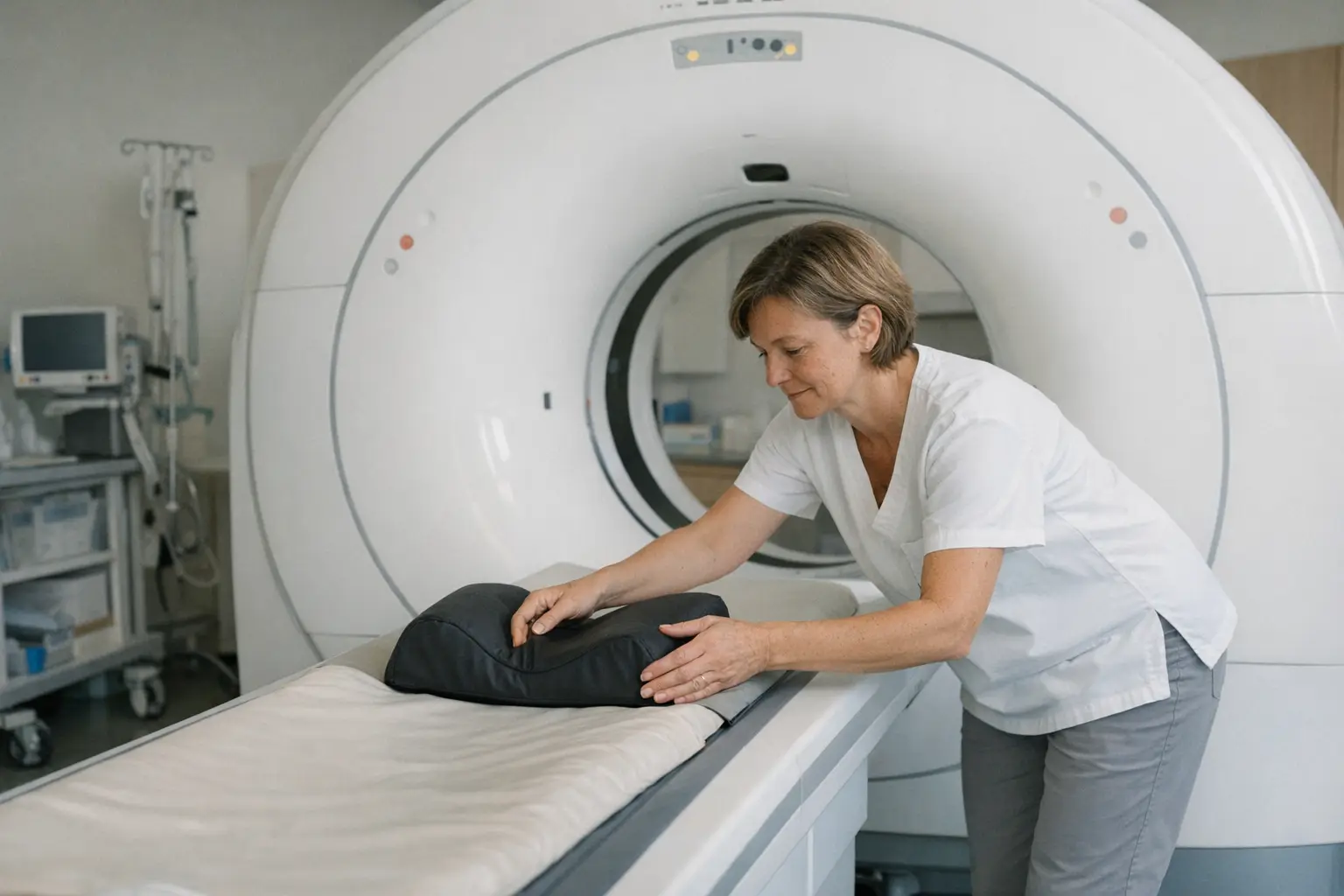
Computed tomography (CT) creates detailed cross-sectional images of the body in just a few minutes using X-rays. It is particularly fast and shows bones, lungs and internal organs very precisely — which is why it is often used in accidents and emergency situations.
Typical Areas of Use
- Investigation following accidents and suspected bone fractures
- Examination of the lungs, for example in cases of persistent cough
- Investigation of unclear abdominal complaints
- Emergency diagnostics, for example in suspected stroke
- Precise planning before procedures
How It Works
- 1You complete a short questionnaire; depending on the clinical question, access for contrast medium is placed in an arm vein.
- 2You lie on a table that moves slowly through the ring-shaped opening of the machine — unlike MRI, the CT is brief and open.
- 3During the scans, the staff will ask you via loudspeaker to briefly hold your breath and remain still; the actual scan takes only seconds to a few minutes.
- 4The images are then reported on by a radiologist; the result is sent to your referring doctor, who will discuss it with you.
How to Prepare
- If contrast medium administration is planned, you may need to fast for several hours depending on the institute; sometimes kidney function is checked beforehand with a blood test.
- Report any known allergies (particularly to contrast medium), thyroid disease and a possible pregnancy.
- Remove jewellery and metal objects in the examination area.
Side Effects & Risks
- CT uses X-ray radiation; modern machines are dose-optimised, and the examination is only used when its benefit justifies the radiation exposure.
- Contrast medium can cause a brief sensation of warmth and a metallic taste — this is normal and harmless.
- Allergic reactions to the contrast medium occur rarely; the team is prepared for this.
- In cases of impaired kidney function, contrast medium can stress the kidneys; therefore kidney function is checked beforehand if necessary.
After a CT scan, you can usually return to your daily routine immediately. After contrast medium administration, drinking plenty of fluids helps to excrete the medium through the kidneys. Contact your doctor if you develop a rash, itching, swelling or breathing difficulties hours after the examination — such delayed reactions are rare but should be investigated.

Cost & Insurance
A CT scan referred by a doctor is generally covered by the mandatory basic insurance; the franchise and deductible apply as usual. A referral by your doctor is customary and sensible, so that the appropriate examination is chosen. If in doubt, ask your health insurer beforehand; this information serves as guidance and is provided without guarantee.
Frequently Asked Questions
- Does a CT hurt?
- No. You simply lie still on the table for a few minutes, nothing more. If contrast medium is injected, you will feel the small needle stick in your arm vein and possibly a brief sensation of warmth.
- How high is the radiation exposure?
- Higher than with a simple X-ray, but modern machines work with dose optimisation. Your doctor weighs the benefits against the exposure and only uses CT when the clinical question justifies it. You must report a possible pregnancy before the examination.
- How long does a CT take?
- The scan itself takes only seconds to a few minutes. With preparation, changing and any contrast medium, you are usually finished within half an hour.
- Is CT also suitable for people with claustrophobia?
- Usually yes: the machine is an open ring, not a long tube, and the examination is very brief. Most people with claustrophobia tolerate a CT much better than an MRI.
- Am I fit to drive after the CT?
- Yes, a CT does not impair your ability to drive. You can drive home directly after the examination.