
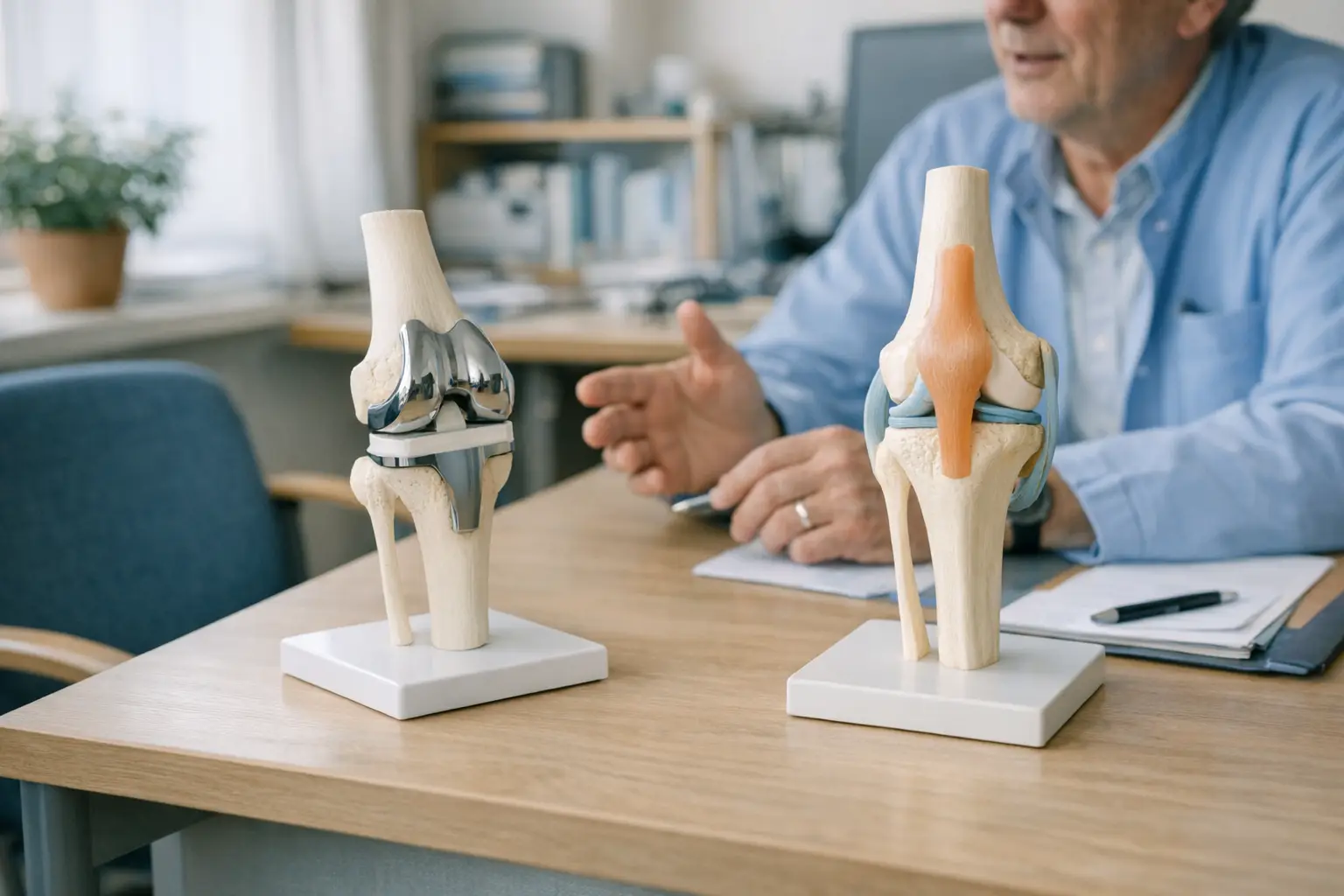
When the cartilage in the knee joint has largely worn away due to arthritis, every step hurts — and eventually physiotherapy and injections no longer provide sufficient relief. An artificial knee joint replaces the worn joint surfaces with metal and plastic components; depending on the extent of damage, as a partial or total replacement. The goal is a largely pain-free, resilient knee for everyday life.
Typical Areas of Use
- Advanced osteoarthritis of the knee
- Pain on weight-bearing and increasingly at rest in the knee
- Instability and axial malalignment (bow legs or knock knees) due to wear
- Significantly limited walking distance despite conservative treatment
How It Works
- 1Following planning consultations, X-rays and the anaesthetic appointment, the prosthesis is precisely planned for your knee — as a partial replacement if only one section of the joint is affected, otherwise as a total replacement.
- 2During the procedure under general or regional anaesthesia, the worn joint surfaces are removed with millimetre precision and replaced by the prosthetic components; a plastic insert takes over the gliding function.
- 3Physiotherapy begins on the day of surgery or the following day with initial steps and bending exercises — early mobilisation improves the outcome.
- 4After a few days in hospital, rehabilitation follows, either inpatient or outpatient, with consistent training of mobility and strength over several weeks.
How to Prepare
- Discuss medications and blood thinners at the anaesthetic appointment; infections — including dental infections — should be treated before the operation.
- If possible, strengthen your leg and core muscles before the procedure; this will pay off during rehabilitation.
- Adapt your home: non-slip pathways, no loose rugs, important items within easy reach.
- Plan for the time after hospital: rehabilitation, household support, transport.
Side Effects & Risks
- Swelling, bruising and wound pain in the first few weeks — often more pronounced with the knee than with the hip.
- Rarely, prosthetic infections requiring thorough, sometimes surgical, treatment.
- Thrombosis and embolism; as a preventive measure, you will receive blood-thinning medication temporarily.
- Restricted movement due to scarring if bending is not consistently practised.
- A small proportion of patients are not fully satisfied with the outcome — realistic expectations are part of good preparation.
The most important task after the operation is practice: the daily physiotherapy exercises for bending and straightening are crucial to the final outcome. Swelling and a feeling of warmth can persist for weeks to months — cooling and elevating helps. Walking sticks will accompany you in the first few weeks. Contact your doctor promptly if the wound weeps or becomes very red, if you develop a fever, if the knee suddenly becomes much more painful, or if your calf swells and hurts. And in future, inform your doctor about the prosthesis if you have any significant infections.
Cost & Insurance
Knee replacement is covered by basic insurance when medically indicated, including a stay in the general ward of a hospital on the cantonal list in your canton of residence; the deductible and co-payment apply as usual. Medically prescribed rehabilitation — inpatient with cost approval or outpatient — as well as the subsequent physiotherapy sessions are also covered by basic insurance. Semi-private or private wards and free choice of hospital require supplementary insurance. If in doubt, consult your insurer — no guarantee.
Frequently Asked Questions
- How severe is the pain after the operation?
- The first few days and weeks are demanding — the knee reacts more sensitively than, for example, the hip. However, with a graduated pain management plan, the discomfort is well controllable, and it decreases week by week.
- How long does rehabilitation take?
- You should expect several weeks of intensive rehabilitation and subsequent training. The knee is often suitable for everyday activities after two to three months; the final result develops over six to twelve months.
- Partial or total replacement — which is better?
- That depends on which sections of the joint are worn: if only one side is affected, a partial replacement may suffice and often feels more natural. Your orthopaedic surgeon will assess what is possible in your case based on the images.
- How long does a knee prosthesis last?
- Modern knee prostheses frequently last 15 to 20 years, often longer. If loosening occurs in old age, revision surgery is possible.
- Can I kneel and play sport with the prosthesis?
- Cycling, hiking, swimming and golf are usually well tolerated; kneeling is permitted but remains uncomfortable for many. Stop-and-go sports with high impact loads are generally not recommended.
- When may I drive again?
- Usually after four to six weeks, when you can control your leg safely and brake firmly — for the right knee rather later than for the left. Discuss the timing at your follow-up appointment.