
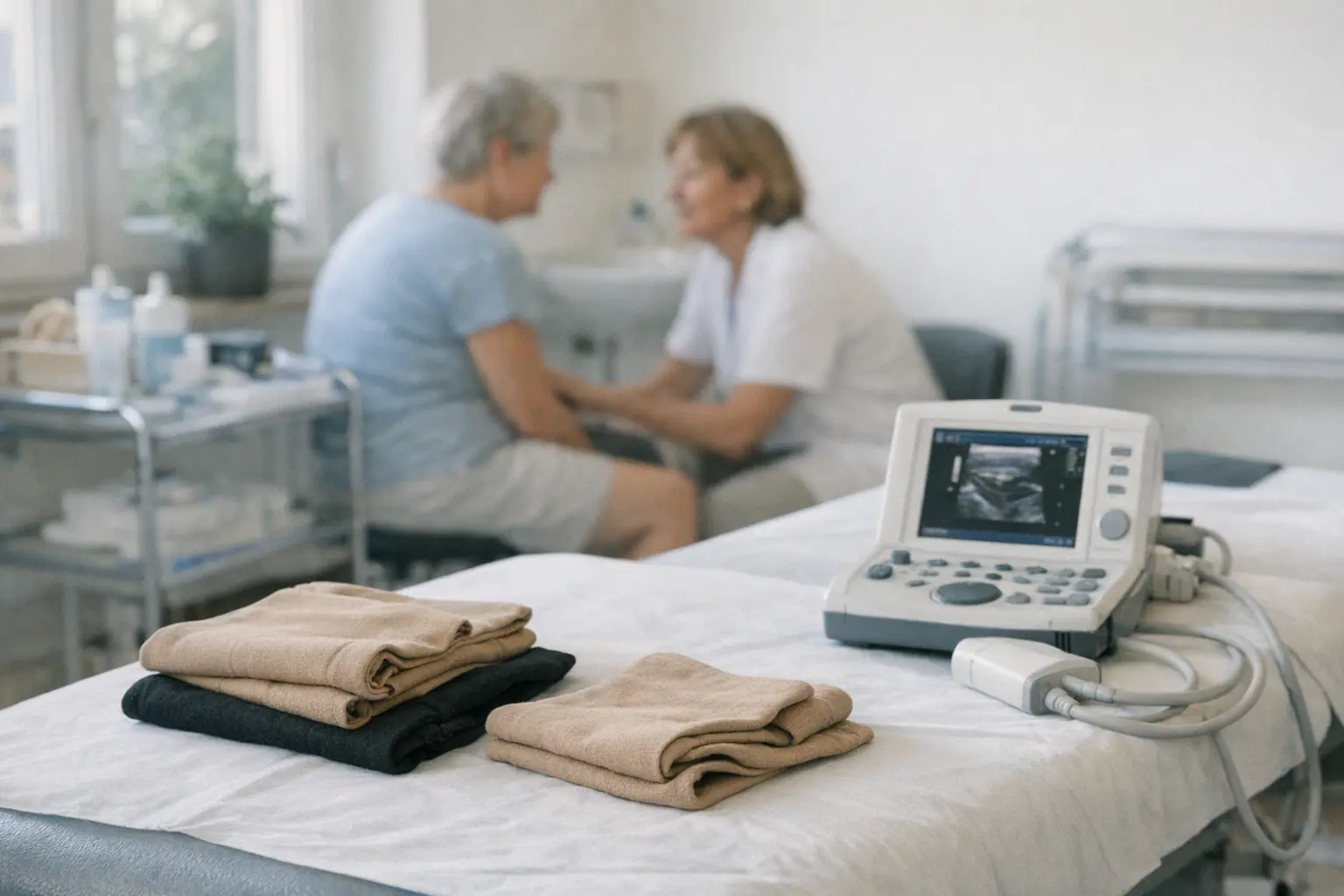
Varicose veins are enlarged, twisted veins, usually in the legs — often harmless, but frequently associated with heavy, tired legs, swelling or itching. Today, treatment is usually gentle: sclerotherapy, laser or radiofrequency procedures via a small access point or — when necessary — a minor operation. Ultrasound examination of the veins shows which method is suitable.
Typical Areas of Use
- Visible, twisted varicose veins on the legs
- Heavy, tired or swollen legs in the evening
- Itching or feeling of tension over the veins
- Skin changes on the lower leg due to venous insufficiency
- Prevention of complications such as phlebitis
How It Works
- 1It begins with an ultrasound examination of the leg veins: this shows which venous valves are leaking and determines the appropriate method.
- 2Small veins and minor varicose veins are often treated with sclerotherapy: an agent is injected into the vein, causing it to close and be reabsorbed by the body.
- 3Larger trunk veins are usually closed from the inside using a catheter with heat (laser or radiofrequency) — under local anaesthetic via a tiny access point.
- 4In selected cases, the vein is removed in a minor surgical procedure; this is also usually done on an outpatient basis today.
- 5Immediately after treatment, you receive a compression stocking and should walk right away — movement is part of the therapy.
How to Prepare
- Obtain the prescribed compression stockings before your appointment and bring them with you.
- Wear comfortable, loose clothing and avoid applying creams to your legs on the day of treatment.
- Discuss blood-thinning medication with your doctor in advance.
- Depending on the procedure, arrange for someone to accompany you home.
Side Effects & Risks
- Bruising, hardness and feeling of tension along the treated vein — common and temporary.
- Brownish discolouration of the skin, which usually fades but may rarely remain visible longer.
- Rarely phlebitis or allergic reactions to the sclerosing agent.
- Very rarely thrombosis; follow the recommended movement and compression.
- New varicose veins may develop over the years — the predisposition remains.
After the treatment, wear the compression stocking as prescribed — depending on the procedure, for a few days to weeks — and walk a lot every day; prolonged standing and sitting as well as intense heat (sauna, sunbathing) should be avoided at first. Bruising and pulling hardening along the vein are normal and will resolve on their own. Please get in touch if a leg swells severely or hurts, if a red, hot cord forms, if fever occurs, or if sudden shortness of breath develops — the latter would be an emergency.
Cost & Insurance
Treatment of medically relevant varicose veins — confirmed by ultrasound examination — is usually covered by basic insurance; the deductible and co-payment apply as usual. Purely cosmetic treatments, such as sclerotherapy of fine spider veins without disease value, however, you pay yourself. Have it explained to you in advance what is considered medically indicated in your case, and if in doubt, ask your insurer — no guarantee.
Frequently Asked Questions
- Does varicose vein treatment hurt?
- Sclerotherapy is barely painful — you feel fine needle pricks. With laser and radiofrequency procedures, local anaesthetic ensures you perceive only pressure at most. Afterwards, pulling discomfort is possible for a few days.
- How long do I have to wear the compression stockings?
- Depending on the procedure, from several days to several weeks — your doctor will determine the duration. Consistent wearing improves the result and prevents discomfort.
- Will I be fit for work after treatment?
- Usually yes: after sclerotherapy or catheter therapy, many can return to work the next day; physically demanding activities may take a little longer depending on progress. Movement is explicitly encouraged.
- Won't the body miss the vein?
- No. Only diseased, leaking veins whose function is already impaired are treated. Afterwards, blood flows through the healthy, deep veins — often even better than before.
- Can varicose veins come back?
- Yes, the predisposition to venous insufficiency remains, and new varicose veins may develop over the years. Exercise, weight control and compression when needed counteract this; follow-up examinations help with early intervention.
- Does health insurance pay for the treatment?
- With medical indication documented by ultrasound, basic insurance usually covers the costs. Purely cosmetic procedures such as spider vein sclerotherapy are at your own expense — if in doubt, check with your insurer in advance.