
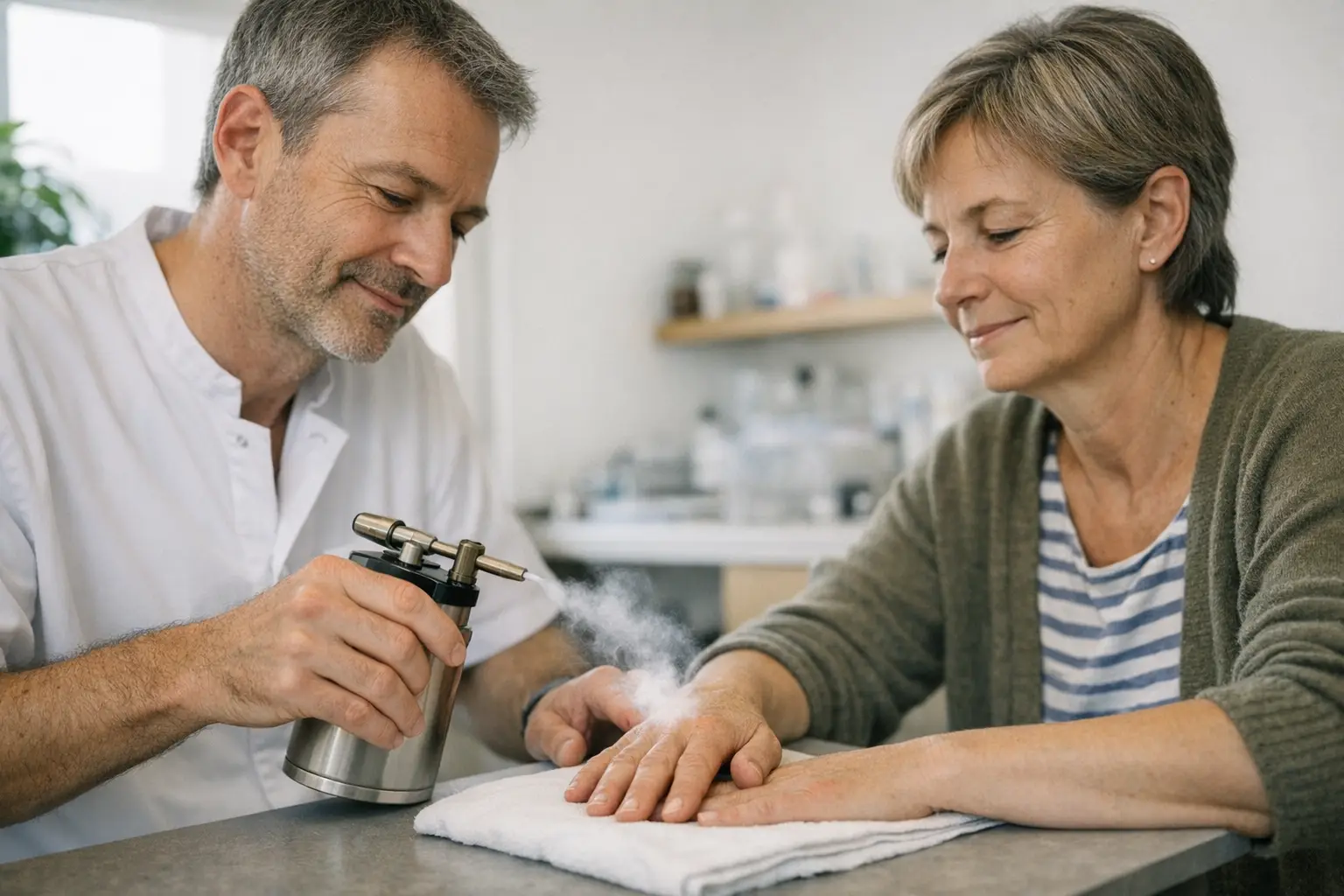
In cryotherapy, skin lesions are treated with extreme cold: liquid nitrogen at around minus 196 degrees is briefly sprayed or dabbed on, causing the altered tissue to die off in a targeted way; the body then sheds and replaces it. Freezing is a quick, well-established procedure in dermatology practice — primarily for warts and actinic keratoses, which are sun-induced early forms of non-melanoma skin cancer.
Typical Areas of Use
- Common warts on hands and feet
- Actinic keratoses (sun-induced rough patches)
- Seborrhoeic keratoses and other benign skin growths
- Molluscum contagiosum, depending on the situation
How It Works
- 1The dermatologist assesses the skin lesion — if in doubt using a dermatoscope — and discusses whether freezing is the appropriate method or whether a tissue sample is needed first.
- 2The liquid nitrogen is sprayed or applied with a cotton swab for a few seconds; you will feel this as an intense cold-burning sensation.
- 3Depending on the size and thickness of the lesion, the process is repeated once or twice during the same appointment.
- 4The treated area is left uncovered or receives a simple plaster; stubborn warts often require several sessions at intervals of a few weeks.
How to Prepare
- As a rule, no special preparation is necessary.
- For warts on hands or feet, it can help to pre-treat the callus according to medical instructions so that the cold works better.
- Inform the doctor about circulatory disorders, diabetes or known cold sensitivity.
Side Effects & Risks
- Burning pain during and shortly after treatment
- Redness, swelling and often a blister, sometimes with some blood
- Lighter or darker discolouration of the treated skin area, which may persist
- Rarely a small scar or wound infection
- No guaranteed success — warts can return and make further sessions necessary
In the first few days, a blister often forms at the treated site, followed by a crust — both are desirable and part of the healing process: do not puncture the blister, do not scratch off the crust, keep the area clean and protect it with a plaster if needed. Showering is permitted. Healing takes one to three weeks depending on the body site. Contact the practice if the area becomes increasingly painful, shows pus, develops spreading redness, or if you develop a fever — and likewise if the treated lesion grows back or changes after healing.
Cost & Insurance
Freezing of medically relevant skin lesions — such as actinic keratoses or troublesome, pathological warts — is generally covered by basic insurance; the deductible and co-payment apply as usual. If treatment is performed purely for cosmetic reasons, such as for harmless seborrhoeic keratoses without medical significance, it is usually self-pay. A referral to the dermatology practice may be required depending on your insurance model (e.g. GP model) — if in doubt, ask your insurer.
Frequently Asked Questions
- Does freezing hurt?
- Yes, briefly: during spraying you will feel an intense burning or stinging sensation that subsides significantly after a few minutes. Most people find it quite tolerable; for children and sensitive areas, the dose is kept particularly conservative.
- How often do I have to come for treatment?
- Actinic keratoses often respond to just one session. Stubborn warts, especially on the soles of the feet, on the other hand, frequently require two to four treatments at intervals of a few weeks. The doctor will assess progress at each follow-up appointment.
- Is the blister afterwards normal?
- Yes — a blister, even with some blood in it, is part of the desired effect of the cold. Do not puncture it; instead, protect the area with a plaster. It will dry out on its own and heal under the crust.
- Does freezing definitely remove warts?
- Not always: warts are caused by viruses and can return despite correct treatment. Freezing is one of the most proven methods, but sometimes it takes several attempts or a combination with other procedures.
- Can I work and do sport normally afterwards?
- Yes, you are fully functional again directly after the appointment. Only with treated soles of the feet can walking be tender for a few days — comfortable shoes and a cushioned plaster help.