
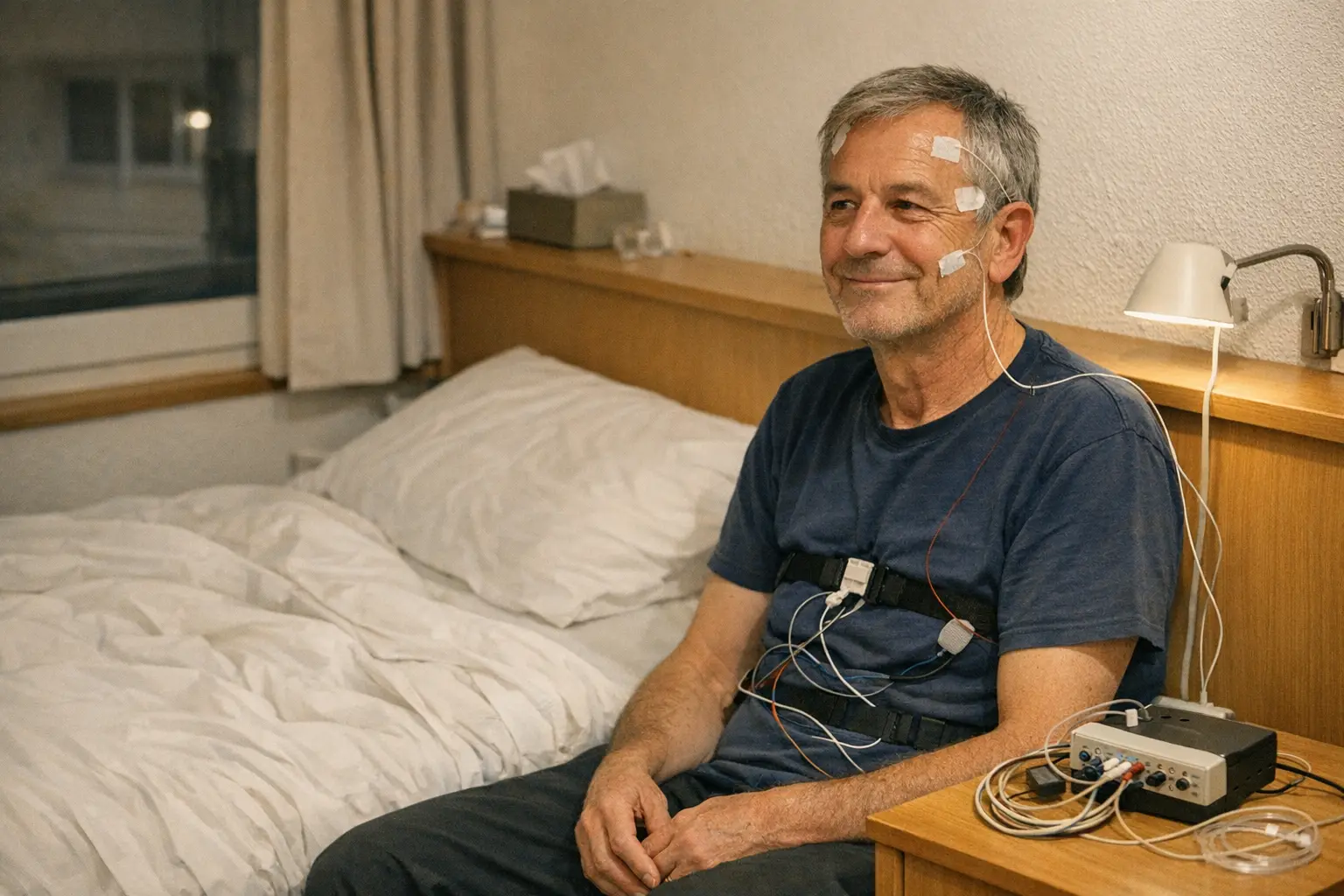
In a sleep laboratory, your sleep is precisely measured throughout an entire night: breathing, oxygen, heartbeat, brain waves and movements. This allows sleep disorders such as sleep apnoea — pauses in breathing during the night — to be reliably detected. Often the investigation begins with a simpler measuring device for use at home.
Typical Areas of Use
- Snoring with suspected pauses in breathing (sleep apnoea)
- Pronounced daytime tiredness and microsleep
- Non-restorative sleep despite sufficient sleep time
- Investigation of persistent insomnia
- Restless legs and conspicuous movements during sleep
How It Works
- 1At the beginning there is a detailed consultation and questionnaires about sleep habits and daytime sleepiness; often an ambulatory measurement with a device that you wear overnight at home follows first.
- 2If the laboratory examination is needed, you arrive in the evening and are given your own room, which resembles a hotel room rather than a hospital room.
- 3The specialist attaches sensors: electrodes on the head and chin, belts around chest and abdomen, a probe on the nose and a clip on the finger — wired, but allowing movement.
- 4You sleep as normally as possible; the signals are recorded and monitored throughout the night.
- 5In the morning the sensors are removed; after the evaluation, the doctor discusses the results and any treatments with you — in the case of sleep apnoea, for example, nocturnal positive pressure therapy (CPAP) or a dental splint.
How to Prepare
- Keep to your usual routine on the day of the examination and avoid alcohol as well as excessive caffeine.
- Take your medications as usual and notify the sleep laboratory of these in advance.
- Pack as for an overnight stay: comfortable nightwear, toiletries and whatever you need for your evening routine.
- Arrive with freshly washed hair and skin, without any cream applied — this helps the sensors adhere better.
Side Effects & Risks
- The examination is physically risk-free — only measurements are taken.
- The unfamiliar environment and the sensors may affect your sleep somewhat; this is known and is taken into account in the evaluation.
- Adhesive electrodes may cause minor, temporary skin irritation.
After the night in the sleep laboratory, you can return directly to your daily routine; residues of electrode paste can be easily washed out. The evaluation takes a few days — do attend the follow-up appointment, as untreated sleep disorders such as sleep apnoea place long-term strain on the heart and circulation. Important: if you suffer from pronounced daytime sleepiness or have almost nodded off at the wheel, raise this openly — fitness to drive is a serious matter until effective treatment is in place.

Cost & Insurance
Sleep investigations are generally covered by basic health insurance when they are referred by a doctor and medically justified — this applies both to ambulatory measurement at home and to the night in the sleep laboratory; the deductible and co-payment apply as usual. A prescribed positive pressure therapy (CPAP) is also covered by basic insurance under certain conditions. If in doubt, ask your health insurance provider; this information is for guidance only and without guarantee.
Frequently Asked Questions
- Can I sleep at all with all those cables?
- Most people sleep better than expected — the sensors are light, and you can turn over with them and go to the toilet. Even if sleep is somewhat shorter or more restless, the recordings are almost always sufficient for a reliable evaluation.
- Do I absolutely have to go to the laboratory or can it be done at home?
- Many investigations begin with an ambulatory measuring device that you wear overnight at home — especially when sleep apnoea is suspected. The laboratory is used when home measurement is not sufficient or more complex sleep disorders are suspected.
- How do I even notice if I have pauses in breathing?
- Often you don't notice yourself — typical signs are loud, irregular snoring, pauses in breathing observed by your partner, waking at night with palpitations, as well as headaches and severe tiredness during the day.
- What happens if sleep apnoea is diagnosed?
- Depending on severity, the doctor will discuss the options with you: from weight reduction and sleep position training to a mandibular advancement splint or nocturnal positive pressure therapy (CPAP), which reliably prevents pauses in breathing.
- Am I allowed to drive with untreated sleep apnoea?
- With pronounced daytime sleepiness, fitness to drive is indeed impaired — microsleep at the wheel is a real danger. Speak openly with your doctor about this; with effective treatment, fitness to drive is usually restored.