
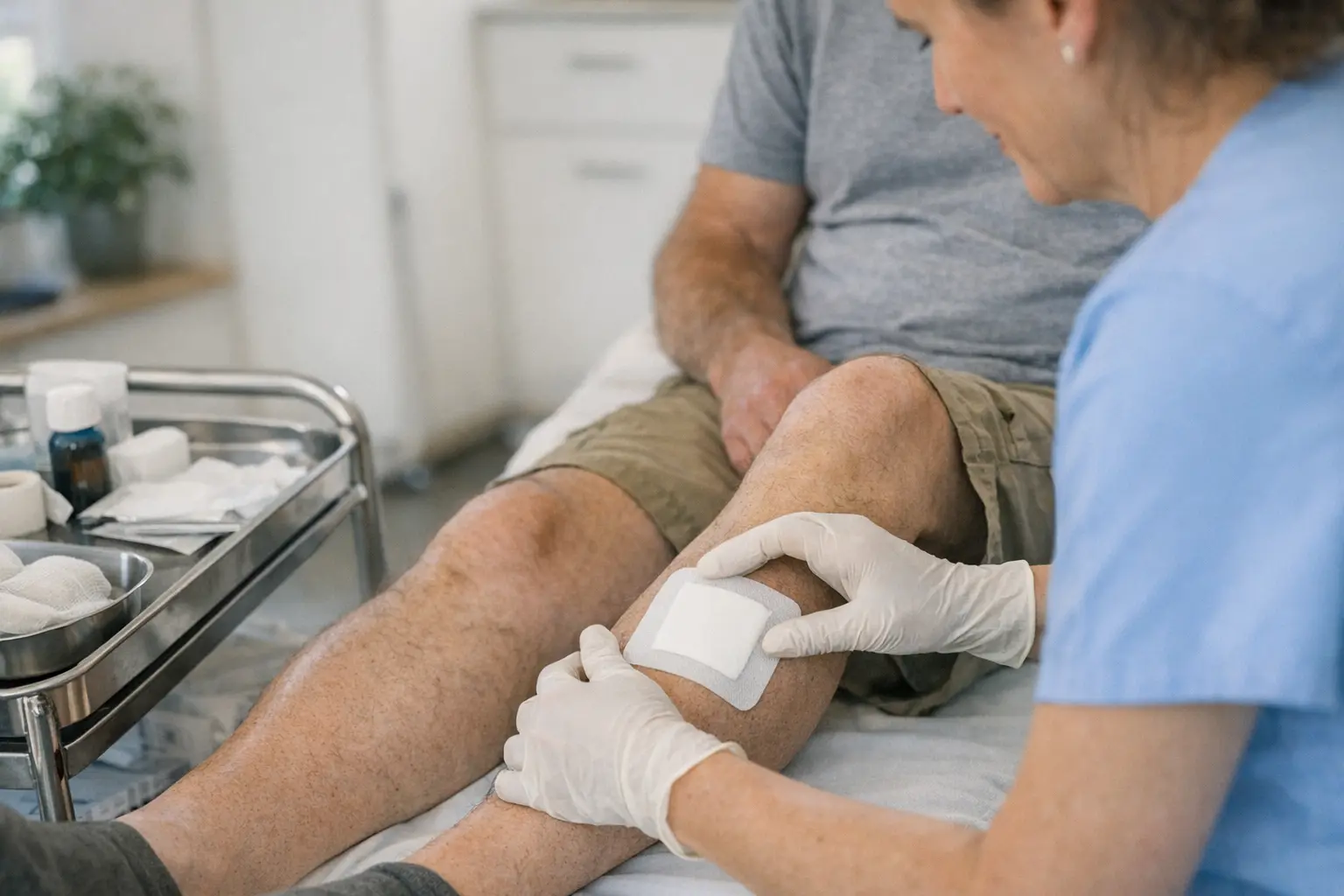
Professional wound care treats wounds that do not heal on their own — such as open sores on the legs, pressure ulcers, or poorly healing wounds in diabetes. Specially trained healthcare professionals clean and dress the wound regularly with modern wound dressings and at the same time treat the underlying cause of impaired healing. A chronic wound will only heal when both aspects are addressed together.
Typical Areas of Use
- Leg ulcers caused by venous disease (ulcus cruris)
- Poorly healing wounds in diabetes, especially on the foot
- Pressure ulcers in bedridden patients
- Impaired wound healing after surgery
- Chronically infected or weeping wounds
How It Works
- 1First, the wound is carefully assessed and the underlying cause is investigated — for example by examining blood circulation, veins, or blood sugar control, as the treatment depends on this.
- 2At each dressing change, the wound is gently cleansed, dead tissue is removed if necessary, and the surrounding skin is cared for.
- 3A modern wound dressing appropriate to the healing phase is then applied, creating a favorable moist healing environment; depending on the cause, compression bandages or pressure relief may be added.
- 4Progress is documented, often with photographs, and the treatment is continuously adapted to the healing progress.
- 5Dressing changes take place either in the surgery, in a wound clinic, or through Spitex at your home, depending on the wound.
How to Prepare
- Leave the existing dressing in place for your appointment — the healthcare professionals will remove it properly.
- Wear clothing that allows easy access to the wound.
- Bring your medication list, especially details of blood thinners and diabetes medications.
- Note down any observations since the last change, such as pain, discharge, or odor.
Side Effects & Risks
- Dressing changes can be briefly painful; do speak up, and the procedure will be done more gently or pain relief will be discussed.
- Despite good care, a wound can become infected — regular checks serve to detect this early.
- The skin can become irritated or react allergically to wound dressings or care products; the material will then be changed.
- Compression bandages can feel unfamiliar at first and may press; they will be adjusted until they fit properly.
Between changes, the dressing should remain dry and in place — protective films help when showering, and you should not alter the dressing yourself. Mild sensations of tightness and some wound fluid in the dressing are normal. Contact your healthcare provider before the next appointment if the wound becomes significantly more painful, redness spreads, the dressing becomes soaked through, an unpleasant odor develops, or fever and chills occur — these can be signs of infection that require prompt treatment.

Cost & Insurance
Medically prescribed wound care is generally covered by the basic insurance — whether in the doctor's surgery, in a wound clinic, or provided by Spitex home care services; prescribed dressing materials are also reimbursed according to current regulations. The deductible and co-payment apply as usual, and for Spitex nursing services there may also be a limited patient contribution. If in doubt, contact your insurance company — this information is provided for guidance only, without guarantee.
Frequently Asked Questions
- Does the dressing change hurt?
- It can be uncomfortable, but modern wound dressings can usually be removed gently. Do say if you are in pain — the approach can be adjusted, and if necessary pain relief will be discussed beforehand.
- Why doesn't my wound simply heal on its own?
- Behind a chronic wound there is almost always an underlying cause such as impaired blood circulation, venous disease, diabetes, or constant pressure. As long as this cause is not treated as well, healing cannot progress — this is why wound care and treatment of the underlying cause go together.
- How long does it take for a chronic wound to close?
- This varies greatly and depends on the cause, size, and your state of health — often it takes several weeks to months. More important than speed is that the wound steadily becomes smaller; progress is documented regularly for this purpose.
- May I shower with the dressing on?
- Often yes, using water-repellent protective films or special dressings. Ask the wound care team what applies to your dressing — bathing and prolonged soaking are generally not advisable.
- What does wound care cost?
- When medically prescribed, the treatment and prescribed materials are generally covered by the basic insurance; you pay the deductible and co-payment, and possibly a limited patient contribution for Spitex services. Your insurance company can provide precise information if in doubt.